




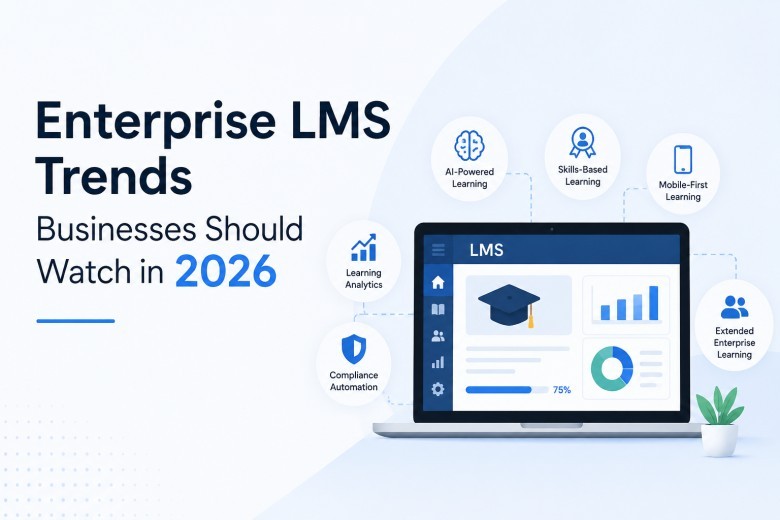
Corporate LMS solutions are taking on more functions than simply providing courses and keeping track of who completed them. According to experts, by 2026 companies will use LMS systems more actively to support workforce development, close skills gap, ensure compliance and align learning with wider business strategy.
As employees' roles evolve, organizations will need learning systems that are flexible, data-driven and simple to operate. Here are the enterprise LMS trends expected to influence corporate learning in 2026.
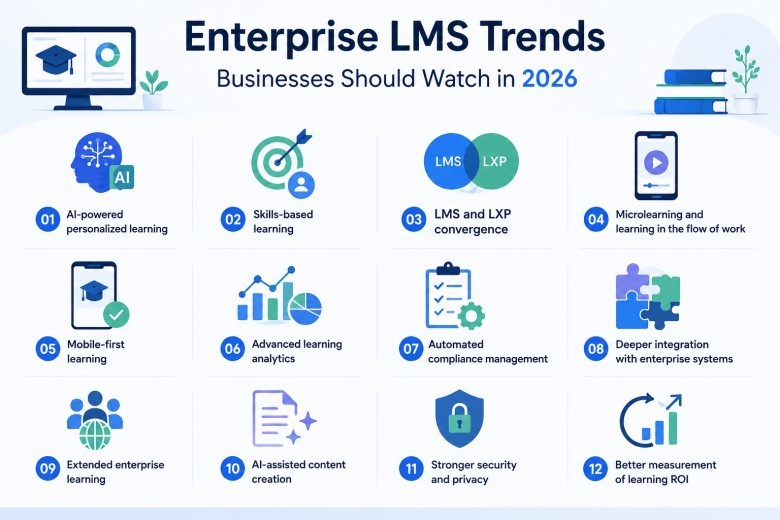
AI-based individualized education
Artificial intelligence is now a common feature of corporate LMS platforms. AI provides course suggestions based on an employee’s position, qualifications, learning history, and future aspirations rather than offering identical training to everyone. It can also detect knowledge gaps, generate assessments, summarize content, and provide real-time learning support. An experienced enterprise LMS development company can help businesses integrate these AI capabilities into a platform tailored to their workforce and training goals. For employers, this makes training more relevant while reducing the manual workload of learning and development teams.
Competency-oriented education
The majority of modern companies discontinue training focusing solely on job titles. The focus now lies on the specific competencies necessary for workers in order to succeed in their jobs. Competency-based learning management systems enable companies to analyze their current competencies, identify weaknesses, recommend learning practices, and facilitate personnel movement within the company.
The convergence of LMS and LXP
The line between traditional LMS systems and learning experience platforms is blurred.
Organizations nowadays require an all-in-one solution that caters to structured training, compliance initiatives, content discovery, tailored recommendations, social learning, and self-paced learning. As a consequence, LMS providers are merging tools for administration with user-friendly and enjoyable experiences.
Microlearning and learning in the context of work
Long training sessions are increasingly becoming impractical for busy employees. As a result, by 2026, more organizations will have started using short learning modules that can be completed in just a few minutes.
Microlearning allows employees to acquire knowledge without disturbing their working hours and supports learning in the context of work, which means that employees have access to training exactly when they need guidance.
Mobile-first learning
Apart from hybrid teams, distributed workforces and frontline employees, the need for mobile access has also become one of the requirements for modern LMS.
Thus, modern platforms must provide responsive interfaces, offline access, notifications, mobile assessments, and synchronization of progress across different devices.
Advanced learning analytics
Completion reports aren’t sufficient for enterprises any longer. Companies need to analyze if training leads to improved skills, performance, and employee engagement.
The modern LMS analytics shows where learners have difficulties, which courses give the best results, where skills gaps exist, and what impact the instruction has on a company’s overall business results. This gives organizations better opportunities to make correct choices regarding the training programs they invest in and create.
Automated compliance management
Compliance training is one of the major use cases of enterprise LMS solutions, especially in regulated industries.
By 2026, companies will increasingly automate course assignments, reminders about certification, escalation processes, reporting, and audit preparation. This helps to reduce administrative work while avoiding missed deadlines or unfinished documentation.
Deeper integration with enterprise systems
An LMS becomes particularly useful when used in conjunction with other systems used within the organisation.
Businesses now expect to integrate their learning management systems with systems responsible for human resources, customer relationship management, collaboration as well as identity management and performance management systems.
Those integrations facilitate provisioning, reporting, delivery of content, and providing learners with personalized tasks.
Extended enterprise learning
Enterprise LMS platforms are being utilized to impart training beyond the limits of an organization.
Companies could design educational programs for their users, partners, suppliers, contractors, franchise owners, or resellers. This results in the need for branded portals, different user groups, multi-tenant capabilities, and access controls.
Extended enterprise education can enable better product use, improve partner relations, and achieve process consistency across business networks.
AI-assisted content creation
Content creation with the aid of artificial intelligence
AI is also transforming the manner in which training content is developed. Learning teams can leverage AI to generate course outlines, quizzes, summaries, translations, scripts, and practical exercises. This enables quick updates of training materials and adaptation to the changes in the business environment.
Although human supervision is still crucial, artificial intelligence is expected to substantially decrease the time taken to develop training programs.
Greater focus on learner engagement
Just completing a course cannot guarantee that employees will acquire valuable knowledge and skills. In 2026, companies are expected to pay more and more attention to engagement, retention, and practical application. The LMS platforms will continue to add new features, including gamification, peer interactions, mentoring, collaborative learning, badges, and tracking of individual progress.
Enhanced security and privacy demands
Since LMS platforms are frequently used by enterprises for managing confidential information of their employees and business, security solutions are highly sought after.
Business organizations are placing more focus on role-based access, a single sign-on, implementation of encryption technologies, audit logs, data residency compliance, as well as adhering to such standards as GDPR, SOC 2, and ISO 27001. These factors have specific significance for big companies dealing in several regions.
Better measurement of learning ROI
Business executives require more transparent data that will prove that the learning programs are providing positive return on investments.
Enterprise LMS platforms are becoming more frequently connected with training data metrics such as efficiency, employee engagement, payback period, clients’ satisfaction, or performance, etc. in order to prove how determined the training teams have been in reaching the achievement of the goals set by the company.
Conclusion
By 2026, LMS systems will be advanced and intelligent. The use of AI-based algorithms for personalization, skills-based educational methods, advanced analytics, mobile learning access, automation, and incorporation with other business processes will have great impact on the process of learning systems' selection and establishment in companies.
While searching for LMS systems, businesses must take into account the ones that will provide the support when it comes to rapid changes in the company employees' needs and skills requirements, ensure the protection of business information, and correlate learning with the effectiveness of business processes.

What's your reaction?
You may also like
-

How to Make a Short Business Promo Video Without Losing the Message
-
How to Create Consistent AI Images for a Multi-Visual Content Project
-
How Two People Can Compare Cities Before Turning a Move into a Compromise
-
Why Choose House Cleaners Redding CA for Your Home
-
Planning Roof Replacement Cleanup When Driveway and Yard Access Are Limited or Restricted
-
Designing Outdoor Kitchens for Food Safety, Practical Storage, and Efficient Meal Preparation


Comments
0 comment