




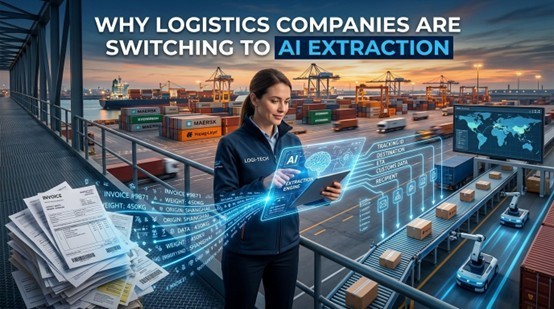
The Logistics Industry Is Facing a Data Explosion
Every logistics operation runs on data. Carrier invoices, shipment records, customs filings, freight quotes, and supplier documents pile up around the clock. A 2024 McKinsey report noted that supply chain data volumes jumped more than 400% over five years, with no sign of slowing down.
That growth creates a real operational problem. Teams that once managed data flows comfortably are now buried. Processing lags behind, decisions stall, and the financial impact follows quickly. In freight operations, a slow data pipeline is not just an IT problem. A slow data pipeline affects the accuracy of billing, the timing of deliveries, and the satisfaction of customers.
- 73% of logistics firms identify data bottlenecks as a primary operational challenge
- $1.9 trillion is lost each year from global supply chain inefficiencies
- Industry analysts project data volumes will double again before 2028
The Breaking Point of Traditional Data Extraction
Most logistics companies built their data workflows around tools that made sense ten years ago. Rule-based OCR systems, manual entry teams, and rigid document templates worked reasonably well when document volumes were predictable and formats were consistent. Neither of those conditions holds today.
Carriers use dozens of different invoice formats. Warehouse staff scan handwritten bills of lading. Customs documents arrive in multiple languages. Legacy extraction tools were never designed for that level of variety, and the results show up in the numbers.
- APQC benchmarks place manual entry error rates at 3 to 5% per document
- Operations teams dedicate up to 40% of working hours to data handling tasks
- Standard OCR tools fail on unstructured documents more than 30% of the time
Hiring additional staff has been the default response to growing data volumes. That approach adds cost without fixing the underlying problem. At some point, the model simply breaks.
What Is Changing? The Rise of AI Extraction
AI-powered data extraction works differently from anything that came before it. Rather than matching fields to templates, it reads documents the way a trained analyst would. Large language models, computer vision, and intelligent document processing work together to interpret structure, context, and meaning simultaneously.
The operational difference becomes immediately noticeable. A traditional OCR tool fails when a carrier labels a field differently than expected. An AI extraction system identifies what the field contains based on surrounding context, regardless of how it is labeled.
Modern logistics AI extraction tools also improve over time. Every document they process adds to the model's understanding of your specific workflows and document types. That continuous improvement is what separates AI extraction from every previous generation of automation.
5 Reasons Logistics Companies Are Rapidly Adopting AI Extraction
Speed Is Now a Competitive Advantage
Document processing that once took hours now completes in seconds. Automated data extraction in logistics means routing decisions get made faster, billing errors surface before disputes begin, and customer queries get answered with accurate data. Speed at the data layer translates directly into speed across the operation.
Data Volume Is Growing Beyond Human Capacity
A mid-sized freight forwarder handling 10,000 invoices monthly today could face three times that volume within a few years. AI document processing for logistics scales to match that growth without proportional increases in staffing costs. The unit economics stay stable regardless of volume.
Accuracy Directly Impacts Profit Margins
On a $10 million invoice portfolio, a 1% error rate costs $100,000 annually. Trained AI extraction models in logistics consistently deliver 97 to 99% accuracy. That improvement over manual processing converts directly into recovered revenue and reduced dispute resolution costs.
Automation Reduces Operational Bottlenecks
Extracted data flows directly into TMS, ERP, and reporting platforms without manual handoffs. Logistics automation tools eliminate the re-keying, approval delays, and reconciliation cycles that slow traditional workflows. Teams shift their attention toward work that actually requires human judgment.
Market Intelligence Is Becoming Critical
The most forward-thinking logistics companies use AI driven freight data extraction to build pricing intelligence, not just process paperwork. Using tools like Live Crawler, businesses can continuously collect carrier rates, lane benchmarks, and surcharge data in real time without manual tracking. Aggregating this information automatically gives procurement teams a real-time view of market conditions that manual methods simply cannot provide.
Where AI Extraction Is Having the Most Impact?
AI data extraction in logistics is delivering real-world results across several important functions. Here’s where organizations are seeing the strongest outcomes:
Shipment & Invoice Management
- AI retrieves line items, charge codes, carrier references and transaction dates straight from documents
- Shorter billing cycles enhance extraction accuracy, reduce dispute rates
- FinOps teams spend more time reviewing exceptions and less time on manual reconciliation
Real-time Positioning Data
- AI gathers status updates, anticipated arrival timings and position feeds from carrier portals and EDI feeds
- Operations teams catch exceptions sooner and react before delays cascade.
- Reliable data becomes available on demand, improving customer service.
Freight Price Intelligence
- AI aggregates rate cards, lane standards, fuel surcharges, accessorial fees
- Procurement teams get real-time market prices, no laborious data collection
- Carrier negotiations become more effective because benchmark data stays current.
Vendor Data Collection
- AI retrieves SKUs, lead times, compliance certificates and performance data from supplier documentation (e.g.
- Supply chain visibility increases across various tiers without increasing analyst workload
- Procurement teams can respond faster and more confidently to supplier data
To explore these use cases in detail and understand how they affect ROI, read this complete guide on AI data extraction for logistics.
The Hidden Cost of Not Adopting AI in Logistics
Holding back on AI-powered logistics data extraction is a business decision with measurable consequences. The costs accumulate quietly but consistently.
- Slow decisions delay routing and responding to problems making it difficult to react to market changes.
- Without accurate freight pricing data, companies often overspend on spot freight, and allow you to miss chances to negotiate better prices with freight carriers.
- Staff inefficiency means that experienced team members spend too much of their time entering data instead of being able to perform other higher-value tasks.
- This allows competitors to improve their ability to rapidly and accurately handle their own data operations every quarter.
Organizations using intelligent document processing for logistics in 2023 and 2024 have spent years training their models with many actual documents. Developing a framework of experience takes significant time. Organizations entering at a later date are at a disadvantage.
What Most Companies Get Wrong About AI Adoption?
Rolling out AI extraction tools for logistics requires more than a technology purchase. Several common errors result in reduced results and erode internal confidence in the process.
Unrealistic timelines are the main friction. AI models learn document patterns over time, and accuracy improves progressively during the first 60 to 90 days. Organizations that evaluate performance too early often draw the wrong conclusions.
Tool selection mistakes are equally costly. A general purpose OCR platform is not a substitute for a purpose-built logistics AI extraction platform. The gap becomes obvious when the tool encounters freight documents with non-standard layouts, multi-currency invoices, or mixed-language content.
Poor input quality undermines strong technology. Unsatisfactory extraction output is the result of blurry scans, incomplete records and irregular document naming conversions. When there is an issue with the quality of the extracted document, it is often due to problems with the actual data and not the AI process used for extraction.
Pilots that focus on one document type and one workflow deliver the clearest early results. That narrow scope gives the model enough volume to specialize and gives stakeholders enough evidence to commit to broader rollout.
Conclusion: From Data Overload to Data Advantage
AI extraction in logistics has moved well past the pilot stage. Freight forwarders, third-party logistics providers, and carriers are deploying it across core operations because the performance gap between AI-assisted and manual data workflows has become too large to ignore.
Organizations that act now gain compounding advantages over time. All of this improves as the model matures with faster processing, higher accuracy and richer data intelligence. Those that delay face a widening structural gap in cost efficiency and operational speed.
Adoption of AI driven data extraction for logistics is no longer a future consideration. For competitive logistics operations, it is a present requirement.

What's your reaction?
You may also like
-

Why Small Roofing Problems Can Become Harder to Diagnose When Homeowners Delay Repairs
-
Planning a Stair Lift for Shared Homes Without Disrupting Everyday Staircase Use
-
Managing Household Waste During Large Decluttering Projects Without Creating New Clutter
-
How to Plan Impact Door Installation Around Security, Access, and Everyday Household Routines
-
How Commercial Roofing Maintenance Planning Helps Property Managers Track Roof Conditions
-
Designing Privacy Around Street-Facing Windows Without Giving Up Useful Natural Daylight
















Comments
0 comment