




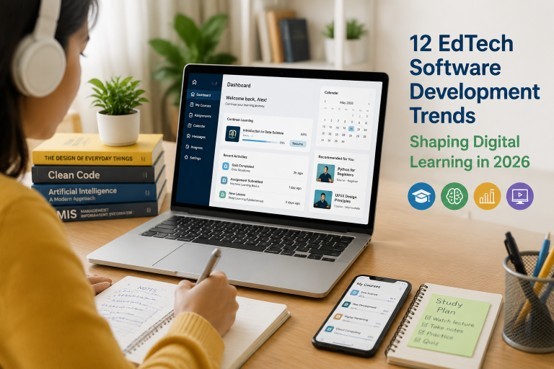
Education technology is about to enter an exciting time of transformation throughout the globe in 2026. We will not just see digital solutions that utilize technology to digitize classrooms; but EdTech software is also beginning to incorporate advanced technologies, personalize learning experiences, and drive data to create new ways to experience education. Software vendors will continue to develop and deploy innovative ways in K–12, higher education and workforce development by delivering more engaging, adaptive, impactful, and effective learning environments.
Key Trends in EdTech Software Development
Explore 12 key trends shaping EdTech software development this year and beyond.
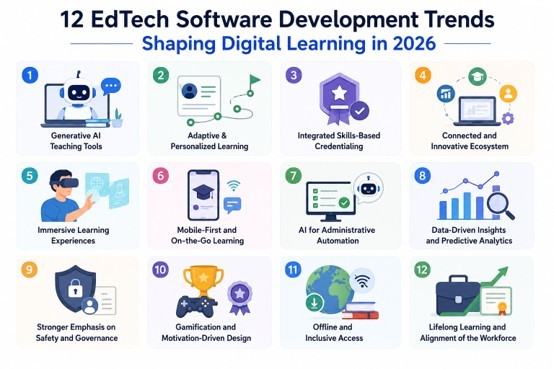
1. Generative AI Teaching Tools
The inclusion of AI teaching tools has become an essential part of how classrooms use technology, developing a system using an advanced large-language model to offer real-time, subject-specific support and a way for a learner to receive peer-like explanations and interact, creating a dynamic conversational learning experience instead of just receiving static content. As long as generative AI technology is applied in practice, it is expected to become increasingly prevalent for enabling homework support, exam preparation resources, and mentorship guidance. This growth is driving demand for edtech software development companies that can design and implement these intelligent, adaptive learning solutions effectively.
2. Adaptive & Personalized Learning
The uses and acceptance of adaptive learning technologies continue to rise as various platforms incorporate them into their offerings to provide students with self-directed, individualised learning experiences by using algorithms to analyse data provided by learners’ interactions and performance to modify the difficulty and the delivery modalities utilised for instructional materials for each learner in such a way as to create a custom learning path for each student thereby helping them bridge gaps in understanding and achieve competency in all areas of content. The effects of personalisation will have expanded by 2026 in three primary aspects – cognitive style, learning rate (speed) and emotional engagement.
3. Integrated Skills-Based Credentialing
Micro-credentials, digital badges and skill certifications continue to rise due to the emphasis put on lifelong learning. More and more EdTech platforms integrate blockchain technology and verifiable credentials for their students, allowing learners to demonstrate the skills they have acquired from various educational institutions and employers. This trend creates a closer relationship between education and workforce needs as learners can create portable skill-based portfolios that help them to move throughout their careers and continue professional development.
4. Connected and Innovative Ecosystem
EdTech continues to move towards developing integrated solutions across all areas of learning. Learning Management Systems, analytics dashboards, Student Information Systems, and administrative software are all part of an integrated solution as they can communicate with each other. With this integration, educators experience a more comprehensive view of their learners’ performance, reduce their administrative workload, and can use data to drive their instructional decisions. In addition, through the creation of integrated ecosystems, educators will have the ability to receive AI driven recommendations that can be used to personalize learning throughout all points of a student’s experience.
5. Immersive Learning Experiences
Experiential Learning is being transformed by new immersive technologies like Augmented Reality (AR), Virtual Reality (VR), and Extended Reality (XR) which allow for students to experience labs, history, or simulation via a computer while in the classroom. By engaging users with "hands on" experiences in an environment that is controlled and safe, these types of technology will increase understanding/interest/retention as compared to other types of experiential learning. With further advancements, accessibility to immersive technologies will become more common through typical mobile devices.
6. Mobile-First and On-the-Go Learning
With learners using more smartphones and tablets, EdTech software, now being created, is being designed with the mobile-first approach. Learning experiences are being created with this flexibility so students can access content whenever and wherever they are. Mobile-first applications allow for micro-learning, and with using push notifications to engage students, offline access to content, and using interactive capabilities, makes it easier and more accessible for all learners located in different geographical regions.
7. AI for Administrative Automation
AI is changing both educational processes and the infrastructure of education. For example, AI platforms can automate grading systems as well as manage attendance records and student schedules; thus providing instructors with additional time to teach their students and mentor them. In addition, AI-powered chatbots provide real-time assistance to students through help with common questions and reinforced learning, leading to improved overall efficiency and responsiveness within the educational system.
8. Data-Driven Insights and Predictive Analytics
Through data-driven insights and predictive analytics, EdTech companies are transforming learning outcomes. By analyzing how learners behave, engage, and perform, AI systems can predict future obstacles and provide intervention strategies, as well as help to realign curriculum. Educators are shifting from a reactive to proactive mode of intervention due to predictive analytics, allowing them to eliminate achievement gaps through tactical support for high-need learners.
9. Stronger Emphasis on Safety and Governance
As education technology depends more on digital information, security, privacy, and governance will become very important. Most platforms use different security measures, ethics-based artificial intelligence procedures, and compliance models to include within their initial layout. To ensure trust with students and others who rely on the data, schools must protect student records, be transparent with how they use algorithms, and provide analytics based on consent.
10. Gamification and Motivation-Driven Design
Gamification and Motivation-Driven Design (Motivation) have developed over time, including behavioral design principles that contribute to increased engagement and motivation of the learner. Instead of just points and badges, gamification platforms include personalization, such as personalized challenges, goal tracking, and community/social aspects. These elements promote persistence and mastery and encourage healthy competition, providing learners with a sense of connection and motivation in the digital world.
11. Offline and Inclusive Access
Access to quality education continues to be an important issue for digital learners. Advances in modern EdTech platforms enable offline use of the platform, low bandwidth support, multi-language content and assistive technologies; therefore, these platforms enable equitable access to high-quality learning materials for all users, regardless of location. Learning to design with inclusivity in mind leads to improved student engagement, retention, and achievement across the spectrum of abilities and connectivity limitations.
12. Lifelong Learning and Alignment of the Workforce
Additionally, EdTech continues to develop toward workforce preparedness and lifelong learning through courses created for emerging job markets, programs for upskilling employees, and pathways for professional development on an ongoing basis. Also, EdTech gives learners the ability to remain relevant in industries that are rapidly changing as it provides opportunities for credential portability and adaptive learning pathways. This allows learners to be able to successfully transition between careers with confidence.
Conclusion
To summarize, the EdTech market in 2026 will be characterized by intelligent, adaptive and learner-centric technology. There are several technology applications in education such as generative AI tutors, immersive XR experiences, predictive analytics and so forth that will assist in the creation of personalized, accessible and measurable educational experiences for educators, administrators and learners alike. By implementing these 12 Emerging Technologies developers and schools are building digital learning environments that are efficient, effective, engaging, inclusive and ready for the future of education for all learners around the world.

What's your reaction?
You may also like
-

Why Small Roofing Problems Can Become Harder to Diagnose When Homeowners Delay Repairs
-
Planning a Stair Lift for Shared Homes Without Disrupting Everyday Staircase Use
-
Managing Household Waste During Large Decluttering Projects Without Creating New Clutter
-
How to Plan Impact Door Installation Around Security, Access, and Everyday Household Routines
-
How Commercial Roofing Maintenance Planning Helps Property Managers Track Roof Conditions
-
Designing Privacy Around Street-Facing Windows Without Giving Up Useful Natural Daylight













Comments
0 comment