




Back-End Development Cost: What Actually Drives the Budget?
The back-end development refers to the back-side of a product that is not seen but is relied upon by users. It is responsible for business logic, database management, user authentication, integration, processing payments, processing information, and communication.
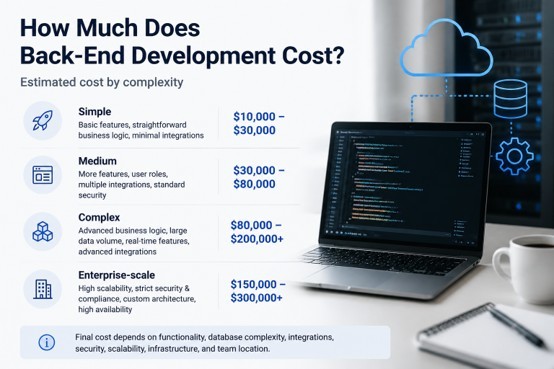
So, how much does back-end development cost? A simple back-end costs approximately from $10,000 to $30,000. A more complex one can have a price tag of around 30,000–80,000. Complex back-end systems may have a budget between $80,000 and $200,000+. The cost of backend development services increases if the system includes integrations with various platforms, processes large amounts of data in real-time mode, or requires high-level security protocols.
Ultimately, the price largely depends on how many integrations and tables are present.
What affects backend development costs?
There are some technical aspects that have the most impact on the cost.
Business logic and functionality
If the application is simple and only needs to process simple requests from users and keep their profiles, development would take less time compared to a logistics or fintech application.
Any features (real-time calculations, recommendations, dynamically changing pricing models, etc.) would increase the amount of time needed for development and testing of the application.
The more work that needs to be done by the backend, the higher its price.
Database complexity
Almost all applications need to store and extract data but the requirements to databases can differ a lot.
A simple application may use extremely simple models of data. A more complex application may need to have a huge amount of data records, different relationships, advanced analytics, techniques of searching through data, etc.
Third-party integrations
Integrations are also responsible for a big part of back-end development. Products may require integration with various payment methods, CRM solutions, maps, messaging services, analytics, identity providers, and so on. Developers are still required to implement authentication, data mapping, error handling, rate limitation, webhooks, and synchronization. Moreover, if the system is legacy or poorly documented, it will take many more resources.
Security requirements
Security is another important factor affecting cost estimates. All back-end elements manage the access to customer information, which implies great importance of security elements. Simple products may require authentication, encryption, authorization, and monitoring. In the case of products used in finance, health, government, or other spheres, security requirements will go far beyond that.
Performance and scalability
Back end construction for just hundreds of users varies greatly from back end setup for handling hundreds of thousands of users.
High-traffic systems can call for implementing caching, load balancing, queueing, optimizing databases, utilizing distributed processing, and using cloud architecture that can be scaled up.
Real-time capabilities like messaging, tracking, and collaborating the back end also add complexity.
Designing for possible growth is very important. Excessive engineering spikes the original costs, while neglecting scalability could mean expensive reconstructions in the future.
Infrastructure and DevOps
Back-end development also includes the environment needed to operate the system effectively.
Projects could require cloud infrastructure, CI/CD pipelines, monitoring and logging mechanisms, backup solutions, and separate environments for development, staging, and production.
Sophisticated systems can necessitate the use of containerization, automated scaling, recovery solutions in case of emergencies, and extensive monitoring systems.
These expenses are usually ignored when people only think of the number of development hours.
Impact of team rates on project budget
Developer rates impact the overall budget of the project considerably.
A typical back-end project can require 1,000 hours and cost $40,000 with a rate of $40/hour and $100,000 with a rate of $100/hour.
This is the reason why many companies outsource dev projects to countries with lower engineering rates.
However, lower hourly rates don’t necessarily mean lower project costs. A skilled and experienced developer can speed up the process of work, make sound architectural solutions and minimize financial risks related to inevitable rework after.
Determining the cost of back-end development
To provide a proper estimate, it is important to define the product requirements first.
From there, the main business processes, user roles, data volume and security must be established. After that, the developers will be able to correctly determine the estimated hours needed for development.
The back-end development cost is calculated by the following formula:
Back-end development cost = hours needed for development * the average employee rate + infrastructure cost + cost of additional services.
For example, in the case when development takes 1200 hours and the rate is $45 per hour, the back-end development cost will be about $54,000.
Ways to ensure that expenses stay low
A good way to control back-end development costs is launching with a confined minimum viable product (MVP).
There is no need for unnecessary integrations, automation, and scalability prior to the emergence of a clear business demand. It is also wise to make use of established technology and dependable third-party services to cut down on customization process.
Yet, there are fields that do need respective investments. Databases, security, APIs, and core architecture will need considerable funds spent on changes later, so making investments from the outset is reasonable.
Final thoughts
The expenses associated with back-end development can differ from $10,000 for easy solutions to $200,000 or more for difficult platforms.
Business requirements, database intricacy, and integration, security, and cost, among other issues, affect the cost the most.
Businesses should not restrict themselves to the question of how much the back-end will cost but rather answer the question of what the solution should be delivering right now and how it should evolve in the future.
The cost of the properly developed and designed back-end exceeds that of the standard one because of the safety and strength it provides.

What's your reaction?
You may also like
-

How Car Accident Lawyers Help Injured Victims Recover Fair Compensation
-
How to Respond After Being Charged With Assault Family Violence
-
7 Steps San Angelo Injury Victims Should Take After an Accident
-
A Guide to Crafting Authentic and Professional AI Marketing Content
-
What Jordan Traffic Rules Should Rental Car Drivers Follow?
-
Move-Out Cleaning Becomes a Different Job Once the Furniture Is Gone











Comments
0 comment