




retaining an existing one. That statistic has been cited in marketing circles for years and it remains as relevant in 2026 as it ever was, perhaps more so given how competitive the paid acquisition landscape has become across most eCommerce categories.
Yet the majority of WooCommerce store owners spend a disproportionate amount of their time, budget, and attention on acquisition. Getting new customers in the door while existing customers quietly drift away is one of the more common and costly patterns in eCommerce and it tends to go unnoticed until revenue growth stalls despite consistent marketing spend.
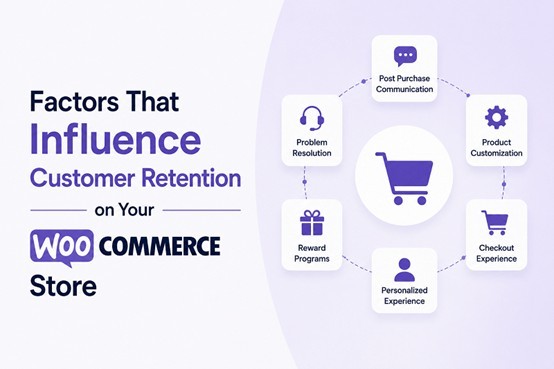
Customer retention is not a single tactic. It is the cumulative result of multiple factors working together across the entire customer experience, from the first purchase through to how the store communicates, what it offers returning customers, and how easy it makes the second and third purchase.
This blog covers the factors that matter most and what store owners can realistically do about each one.
The Quality of the First Purchase Experience
Retention begins before the customer ever comes back. The first purchase experience sets the frame for every subsequent interaction and customers who are genuinely satisfied with that first order are considerably more likely to return than those who were merely not dissatisfied.
This covers several things simultaneously. Product quality is the obvious one but beyond that it includes how accurately the product page described what the customer received, how the order was packaged, how the delivery timeline matched what was communicated at checkout, and what the experience of contacting support looked like if anything went wrong.
What we have observed is that the stores with the highest retention rates are not necessarily selling the best products in their category. They are selling products that consistently match customer expectations, packaging them with care, and handling problems when they arise in ways that leave the customer feeling valued rather than processed.
The gap between expectation and reality is what drives customer churn after a first purchase and closing that gap is the foundation of everything else in this list.
Post-Purchase Communication
What a store does in the days and weeks after an order is placed has a significant effect on whether the customer returns and most stores either do too little here or do it in a way that feels automated and impersonal.
Effective post-purchase communication in 2026 looks like:
- Order confirmation and shipping updates that are proactive and specific rather than generic. Telling a customer their order shipped and giving them a real estimated delivery date is meaningfully better than a templated email with a tracking link and nothing else
- A follow-up message after delivery asking whether everything arrived correctly and whether the customer has any questions about the product. This is something large retailers rarely do and small stores can do genuinely well
- A review request timed appropriately for the product type. A review request sent twelve hours after delivery before the customer has had time to use the product gets ignored. One sent at the right moment with a personal tone gets responses
- Relevant product recommendations based on what the customer actually bought rather than generic bestseller lists. A customer who bought a coffee grinder is more likely to respond to a recommendation for filters or a cleaning brush than to a recommendation for unrelated products
Email remains the most effective channel for post-purchase communication and programs like Klaviyo, Mailchimp, and ActiveCampaign give WooCommerce store owners the segmentation and automation capabilities to make this communication feel timely and relevant without manually managing every message.
The Returns and Problem Resolution Experience
Returns are often treated as a cost center to be minimized rather than a customer relationship touchpoint to be optimized. Research from Narvar consistently shows that a positive returns experience is one of the strongest predictors of repeat purchase behavior and yet most stores invest almost no attention in making this process good.
A customer who needed to return something and found the process clear, fair, and hassle-free is often more loyal after the return than they were before it. A customer who needed to return something and found the process confusing, slow, or adversarial is almost certainly gone permanently.
The practical elements that make a difference:
- A returns policy that is easy to find and written in plain language without excessive conditions that feel designed to discourage returns
- A process that does not require the customer to jump through multiple hoops to initiate a return
- Proactive communication about the status of the return and refund without the customer having to chase for updates
- A resolution that arrives promptly and without argument when the issue is legitimate
Loyalty and Reward Programs
Loyalty programs work because they create a concrete financial reason for a customer to return to a specific store rather than shopping around for the best price on each individual purchase. In 2026 the most effective loyalty implementations for WooCommerce stores are those that make the earned value feel genuinely meaningful rather than accumulating points toward a reward that feels perpetually out of reach.
A few approaches worth considering:
- Points-based systems where purchases earn points redeemable against future orders. WooCommerce extensions like WooCommerce Points and Rewards and YITH WooCommerce Points and Rewards handle this natively
- Tiered loyalty programs where spending thresholds unlock progressively better benefits. The aspiration to reach the next tier is a retention mechanic in itself
- Cashback models where a percentage of each purchase is credited toward the next order. These tend to feel more tangible to customers than abstract point accumulation
- Exclusive member pricing or early access for registered customers which creates a status-based reason to maintain the relationship with the store
The key across all of these is making the earned value visible and accessible. A loyalty program that customers forget exists because they never see their balance is not retaining anyone.
Personalization Across the Shopping Experience
Generic shopping experiences produce generic retention rates. Customers in 2026 have been exposed to enough personalized experiences from large retailers that they notice and appreciate when a smaller store does it well, and they notice when every experience feels identical regardless of their history with the store.
Personalization for WooCommerce stores does not require enterprise infrastructure. It requires attention to what information is already available, specifically purchase history, browsing behavior, and account information, and using that information thoughtfully.
Practical personalization that is achievable for most WooCommerce stores:
- Showing returning customers different homepage content or featured products based on their previous purchases
- Sending birthday or anniversary emails with a genuine offer rather than a generic promotional blast
- Segmenting email communication so customers who bought in a specific category receive recommendations and content relevant to that category
- Remembering customer preferences so they do not have to re-enter information they have already provided
Product Customization and the Ability to Offer Something Unique
One of the more underappreciated retention factors is the degree to which a store offers customers something they cannot get elsewhere in exactly the same form. Price competition is one-dimensional. If a customer can find the same product at a lower price from a competitor with a comparable shipping experience there is limited reason to return to the original store.
Product customization changes that equation because a personalized product is by definition not available from a competitor in the same form. A customer who has had a product made specifically to their preferences has a reason to return to the store that made it rather than shopping around.
This is where plugins that enable proper product customization become a retention factor rather than just a feature addition.
Getting a WooCommerce product addons plugin, preferably by Extendons, gives stores the ability to add configurable custom fields, paid optional extras, and conditional logic-based options to product pages. From a customer retention perspective, its contribution is specific and worth understanding.
When a customer can build a product to their preferences through WooCommerce product addons, selecting a color combination, adding personalization text, uploading a design file, choosing an optional extra service, they invest more of themselves in that purchase. That investment creates a stronger connection to the product and the store that enabled the customization.
The features within the plugin that most directly support retention include:
- Paid optional extras like gift wrapping, priority processing, or premium materials that allow the store to offer additional value to customers who want it without changing the base product price for those who do not
- Conditional logic that makes the customization experience feel intelligent and relevant rather than overwhelming customers with irrelevant fields
- Mandatory and optional field differentiation that guides customers through the customization process without creating friction for those who want a simpler order
- Per-item pricing on repeated fields for stores where each item in a multi-item order can be individually personalized
The result is a shopping experience that creates genuine product differentiation in a way that standard fixed-product listings cannot replicate and that gives customers a reason to return to the specific store that offered it rather than the nearest price comparison alternative.
And for those worried about going through the hassles of a setup process that requires extra effort, the product add ons WooCommerce plugin has its own documentation as a guide, making installation super easy.
The Checkout Experience
Checkout abandonment and post-checkout dissatisfaction are both retention problems even though they look like different issues on the surface. A customer who abandons checkout due to friction is a customer who has not yet become a retained customer. A customer who completes checkout but finds the process confusing or unexpectedly expensive is less likely to come back.
The checkout factors that most consistently affect retention:
- Transparent pricing throughout the purchase journey so there are no cost surprises at the checkout stage
- A minimal steps checkout that does not require unnecessary account creation or information entry
- Multiple payment options that include digital wallets since mobile checkout completion rates are significantly higher when Apple Pay or Google Pay are available
- Clear delivery time communication at checkout so the customer knows what to expect before they complete the purchase
Plugins like the Conditional Checkout Fields extension by FmeAddons allow stores to collect specific order information at checkout without adding unnecessary fields for customers whose orders do not require that information. Keeping the checkout relevant and clean for each customer reduces abandonment and starts the post-purchase experience on a positive note.
The Account Experience
A customer who has created an account and found it genuinely useful is more likely to return than one who created an account only because checkout required it and found the account area to be a generic, uninformative page.
The WooCommerce My Account page is an underinvested retention touchpoint for most stores. A well-configured account area that gives customers easy access to their order history, relevant store content, loyalty information, and personalized navigation creates a reason to log in and engage rather than treating the account as a forgotten utility.
Plugins like the Customize Account Page and User Dashboard by Extendons allow stores to add custom endpoints, role-based content, banners, and visual customization that turns the account area into something customers actually find useful and return to voluntarily.
Consistent and Relevant Marketing Communication
Not all marketing communication retains customers. Communication that is too frequent, too generic, or not relevant to the customer's actual interests tends to produce unsubscribes rather than repeat purchases.
The communication habits that support retention are:
- Segmentation by purchase behavior so customers receive recommendations and content related to what they actually bought rather than broadcasts that apply to everyone equally
- Frequency calibrated to the customer's engagement level so highly engaged customers receive more frequent communication and customers who have not opened recent emails receive less
- Value-first content that gives customers useful information, inspiration, or entertainment rather than pure promotional messaging in every communication
- Re-engagement campaigns for customers who have not purchased in a defined period, timed and worded to feel like a genuine outreach rather than an automated reminder
Conclusion
Customer retention on a WooCommerce store is the accumulated result of many decisions across many touchpoints, from the quality of the product and packaging through to post-purchase communication, the returns experience, loyalty programs, personalization, and the checkout and account experiences that frame each interaction.
No single factor determines retention on its own but collectively these factors compound. A store that gets most of them right creates an experience that customers find genuinely preferable to alternatives, even when price competition exists.
You can add a specific and meaningful dimension to your online stores through a product add ons WooCommerce plugin by creating product experiences that cannot be replicated elsewhere, which is ultimately the strongest retention mechanism available to any store.
But the WooCommerce product addons is one factor among many and the stores with the highest retention rates are the ones treating all of these factors with the same deliberate attention rather than optimizing one area heavily while neglecting the others.

What's your reaction?
You may also like
-

Why Small Roofing Problems Can Become Harder to Diagnose When Homeowners Delay Repairs
-
Planning a Stair Lift for Shared Homes Without Disrupting Everyday Staircase Use
-
Managing Household Waste During Large Decluttering Projects Without Creating New Clutter
-
How to Plan Impact Door Installation Around Security, Access, and Everyday Household Routines
-
How Commercial Roofing Maintenance Planning Helps Property Managers Track Roof Conditions
-
Designing Privacy Around Street-Facing Windows Without Giving Up Useful Natural Daylight










Comments
0 comment