




I used to treat PDFs like “future me’s problem.” I’d download a report, a lecture handout, a research paper—then watch the pile grow while my motivation quietly leaked away. The issue wasn’t that the material was useless. It was that the format demanded the most difficult step first: sustained attention, right now.
That’s the mindset shift that made Pdf to Brainrot feel unexpectedly practical in my own testing. Not because it “solves learning,” but because it changes the first mile. Instead of asking you to sit down and read a dense document end-to-end, it helps you turn that same content into a short-form viewing experience—something you can actually start, finish, and replay.
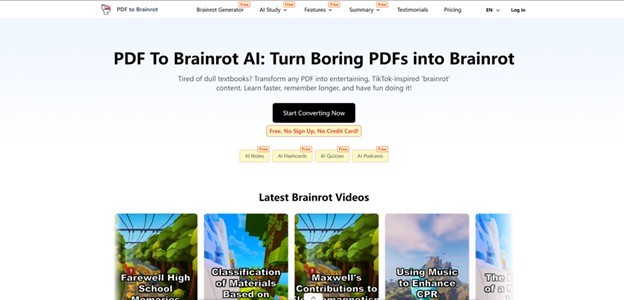
A More Honest Problem Statement: PDFs Don’t Fail You—Your Workflow Does
Most people don’t struggle with information. They struggle with entry cost.
- A PDF is static.
- Your attention is dynamic.
- The mismatch creates delay, and delay creates backlog.
If you’ve ever opened a PDF, scrolled twice, and closed it, you’ve already met the real enemy: friction.
PAS, Reframed as a Habit Problem
Problem
You have valuable PDFs but not the time (or mental runway) to process them properly.
Agitation
Backlog becomes background stress. You “should” be learning—so you avoid it. That avoidance makes the next attempt even harder.
Solution
Reduce the entry cost by converting the material into a format built for short sessions: a narrated, watchable clip you can replay during low-energy windows.
What Changes When You Convert a PDF Into a “Replayable Clip”
The best mental model I found is this:
- A PDF is a library book: high value, high commitment.
- A short-form video summary is a library bookmark: it doesn’t replace the book, but it helps you return to the right pages.
In my use, the output felt most valuable as a “first pass” and a “repeat pass.”
- First pass: Get oriented fast—what is this about, what are the pillars, what vocabulary keeps showing up?
- Repeat pass: Reinforce memory with low effort—watch again, catch what you missed, improve recall.
How Pdf to Brainrot Fits Into a Practical Learning Loop
Instead of positioning this as “content creation,” it’s more accurate to see it as format translation.
Extract
You provide the source—PDF and, depending on the conversion route, other text-like inputs.
Compress
The tool condenses the content into a shorter narrative structure (and in my tests, it tends to prioritize main ideas over nuance).
Rehearse
You receive a video that’s easier to replay than re-reading, which makes repetition more realistic.
This loop matters because repetition is often where learning succeeds—but it’s also where traditional PDFs fail your schedule.
Modes as Learning Strategies, Not “Features”
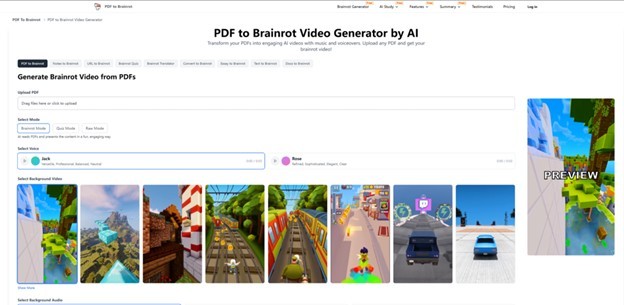
Brainrot Mode
In my tests, this is the “momentum” option—useful when you want a fast, watchable pass that lowers resistance. I used it for long articles and general overviews when my goal was simply: “Don’t let this PDF sit unused.”
Quiz Mode
This is closer to retrieval practice: turning information into prompts that push you to remember, not just recognize. When I used it on study notes, it felt closer to revision than summarization.
Raw Mode
This felt more literal. When I wanted less reinterpretation and more directness, Raw Mode was the safer bet.
The Before/After That Actually Matters
A lot of tools promise “faster learning,” but the more reliable outcome is this:
- Before: You need willpower to begin.
- After: You only need a spare minute.
That’s not marketing. That’s workflow design.
In my case, the most noticeable change was that I stopped “waiting for the perfect study session.” I could preview an idea while doing something else, then return later with more context.
Comparison Table: Where Pdf to Brainrot Sits in the Real World
| Comparison Item | Pdf to Brainrot AI | Reading the PDF Straight | Manual Notes + Summary | Generic Video Editors |
| Primary value | Reduces starting friction; creates replayable review | Highest fidelity and nuance | Deep processing and ownership | Production control and polish |
| Time to first usable output | Low (minutes) | Medium to high | High | Medium to high |
| Best use case | First-pass overview + repeat-pass reinforcement | Deep study, exact wording, details | Exams, mastery, durable understanding | Marketing/video projects |
| Effort required | Low to moderate | Moderate | High | High |
| Replay convenience | High | Low | Medium | Medium |
| Risk of losing nuance | Medium (depends on source) | Low | Low | Variable |
| Ideal mindset | “Help me start and repeat” | “Help me understand fully” | “Help me internalize” | “Help me produce content” |
This table reflects how I’d actually choose between approaches. Pdf to Brainrot is most compelling when your bottleneck is not intelligence, but consistency.
Where It Felt Strongest in My Own Use AI Pdf to Brainrot
Previewing unfamiliar topics
When I didn’t know the landscape yet, a short video helped me learn the vocabulary and main claims quickly.
Repetition without burnout
I’m far more likely to re-watch a short clip than re-read the same pages. That alone made retention more realistic.

What's your reaction?
You may also like
-

7 Tips for acid reflux chest pains 24 7 emergency room Fast
-
How to Choose the Right Brass Tub for Your Bathroom
-
How Enterprise Software Enhances Team Collaboration
-
7 Powerful Benefits of Using a Flashcard Template for Learning
-
7 Smart Tips for Economy Car Rental Jordan Travelers
-
7 Ways Digital Pathology Is Transforming Laboratory Efficiency















Comments
0 comment