




These days, generative AI is more than a passing trend. It will be seen as a crucial part of any contemporary digital strategy in 2026. At the forefront of this change are generative AI development services, which are increasingly being viewed by almost all businesses worldwide, regardless of size, as essential technological investments.
What, then, has caused interest in generative AI to rise so quickly? And why are businesses making generative AI development a top priority in addition to other significant technological investments like cybersecurity and cloud computing?

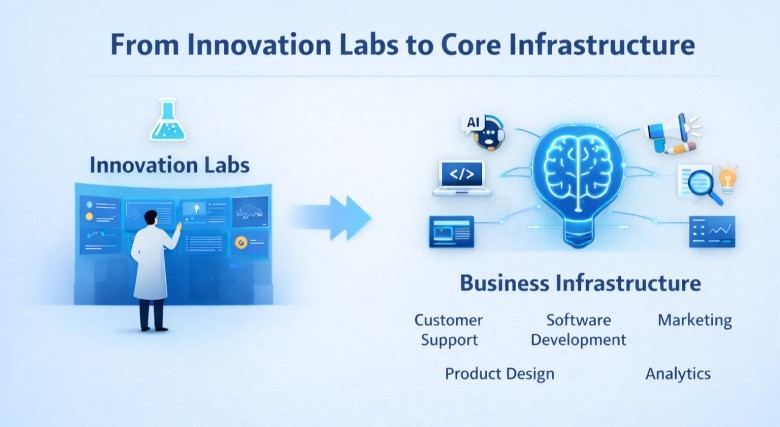
Transforming from Innovation Labs to Core Infrastructure
Generative AI initiatives have mostly been limited to internal innovation projects or proof-of-concept programs over the past few years. But in just a couple of years, this has drastically changed. By the end of 2026, businesses all over the world had adopted generative AI for many of their primary operations, such as:
-
AI-powered customer service agents (e.g., chatbots)
-
Software code generation, testing, refactoring, etc.
-
Marketing & content development (e.g., blog posts, infographics, videos)
-
Analyzing excessive amounts of unstructured data and deriving insights and knowledge through these analyses.
-
Generating innovative product designs through rapid prototyping and ideation
As a result, demand for generative AI development services has increased significantly beyond basic model integration. Companies now require complete end-to-end capabilities encompassing:
-
Developing an AI strategy with aligned business-use cases
-
Building data infrastructure (data engineering and preparation) necessary to ensure that models are accurate and reliable within a given enterprise, organization, etc.
-
Customizing and fine-tuning (through additional proprietary data) existing Generative AI Models and creating new ones.
-
Deploying Generative AI systems securely and integrating with existing Technology Stacks.
-
Monitoring and optimizing the performance of Generative AIs on an ongoing basis
-
Establishing governance procedures over the entire lifecycle of the Generative AIs.
Generative AI is becoming part of business-critical processes. Generative AI is no longer viewed as an experiment and is instead providing a foundational layer to the modern digital іnfrastructure.
Why 2026 Marks a Turning Point
There are three main reasons why 2026 will be an important year for investment in GenAI.
The first reason relates to the maturity of generative AI. The existence of large language models, multimodal systems, and other domain-specific Artificial Intelligence solutions is now common and available to most enterprises.
The second reason for the significance of 2026 as an investment year in generative AI is due to the increasing level of competition. Companies that do not adopt generative AI by 2026 will be at a severe disadvantage relative to their competitors, who are experiencing accelerated development cycles and lower operating costs via the use of generative AI.
The final reason 2026 marks a key turning point for investment in generative AI is a shift in economics. By this point, investing in generative AI development services delivers a clear return on investment, especially when compared to the high upfront costs of early AI development initiatives.
Enterprise Use Cases Driving Investment
Generative AI's high-impact use cases are what drive enterprises to invest in the technology. From software engineering to customer experience or knowledge management, generative AI has been incorporated into main workflow processes. These implementations provide support for complex business-critical functions that span multiple teams.
Off-the-shelf products do not fulfil the needs for these use cases. Therefore, enterprises are increasingly using generative AI development services to create solutions that are tailored to their own use of data, compliance requirements, and industry regulations.
Security, Customization, & Compliance
Whether it is for security, customization, or compliance reasons, companies are investing in building AI capabilities due to the control that they provide over the use of their proprietary data for developing models, implementing governance frameworks, and deploying systems in secure and controlled environments.
With increased AI implementation, compliance has been a key determinant of the professional development of AI. Governments around the world are putting more pressure on organizations to adopt structured risk management and governance procedures. The NIST AI Risk Management Framework is one of the existing frameworks driving how enterprises are developing secure and responsible artificial intelligence solutions.
Strategic Investment in the Future
What distinguishes generative AI from other technologies is its compounding nature; once the AI system is integrated successfully, the AI is increasing in capability over time through its ability to learn from new data and usage.
As such, investing in generative AI development services is not only a one-time project but instead represents a long-term strategic investment for companies creating solid AI infrastructure today and setting themselves up to innovate more quickly and respond to changes in their market while achieving future growth.
Just like cloud computing 10 years ago, generative AI is fast becoming a baseline requirement for all competitive digital products.
Looking Forward
With each passing year, the development of generative AI will play a larger role in the way technology is developed and experienced. As businesses continue their digital transformation journey after 2026, those companies that view generative AI as part of their core infrastructure (rather than as an additional layer of service) will have a competitive advantage.
Business leaders are no longer questioning whether or not they should invest in generative AI development services. Instead, they are trying to figure out how quickly they can implement these solutions.

What's your reaction?
You may also like
-

Why Small Roofing Problems Can Become Harder to Diagnose When Homeowners Delay Repairs
-
Planning a Stair Lift for Shared Homes Without Disrupting Everyday Staircase Use
-
Managing Household Waste During Large Decluttering Projects Without Creating New Clutter
-
How to Plan Impact Door Installation Around Security, Access, and Everyday Household Routines
-
How Commercial Roofing Maintenance Planning Helps Property Managers Track Roof Conditions
-
Designing Privacy Around Street-Facing Windows Without Giving Up Useful Natural Daylight













Comments
0 comment