





How Generative AI Is Changing Legacy App Modernization
Updating older applications is difficult because they provide necessary functions but can be expensive to run, tough to upgrade, and hard to bring into new systems.
Using generative AI makes these updates quicker and easier to accomplish. It can help with analysing code, creating documentation, testing code, organising code, and preparing for moving code so that developers can spend their time strategising about how their applications will fit into their business, protecting the code of these applications, and developing business-focused plans for their applications.
What is legacy app modernization with Gen AI?
Modernizing legacy applications with Gen AI involves utilizing AI capabilities such as analyzing, documenting, testing, refactoring, and migrating legacy applications. Many companies use legacy systems modernization services to help engineers better understand large codebases, automate repetitive processes, identify technical debt, and improve modernization planning.
It should also be noted that senior engineers will not be replaced. Engineers still need to validate AI recommendations, define architecture, mitigate risks, and align application modernization with business objectives.
Primary Uses for GenAI in the Modernization of Legacy Applications
Generative AI can support legacy modernization at every stage, helping teams better understand existing systems, reduce manual work, and plan safer improvements.
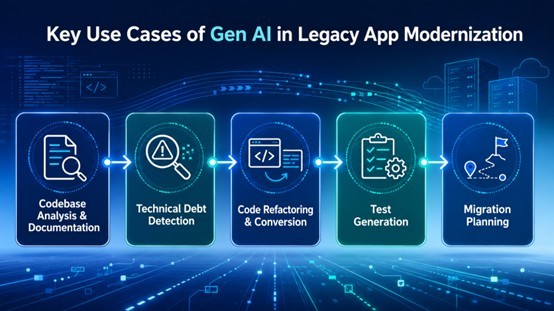
1. Code Base Review/Documentation
There are many legacy systems today that suffer from inadequate/old documentation. The current developers may not fully understand how certain modules work if the original developers are no longer with the organization.
Gen AI has the capability to analyze code and create explanations for functions, modules, dependencies, data flows, and business logic. In addition, it can create new or updated technical documentation (API documentation, onboarding documents, architecture summaries).
Having this level of understanding will enable teams to fully understand the current state of a system before they begin any changes. Increased visibility creates a lower risk of breaking critical functionality during the modernization process.
2. Identifying Technical Debt
Many legacy systems are being created and are often built with duplicated code, outdated libraries, unoptimized queries, unused code and inconsistent coding style. Finding these problems manually can take weeks or even months to complete.
AI can help identify areas where technical debt exists and make recommendations for areas of refactoring that will bring the most value. It can show sections that have high risk (such as modules), areas with excessive complexity (such as functions) and areas that are difficult to maintain.
This allows businesses to better focus their efforts in modernizing rather than trying to modernize everything at once.
3. Refactoring and Code Migration
Refactoring code is one of the most frequent applications of Generative AI. AI tools can help generate cleaner and more maintainable versions of existing code, improve variable naming conventions, simplify logical flow, and help ready existing code to work with newer versions of technology than what was used to develop them historically.
In some cases, Generative AI can assist with converting code from one programming language to another. Examples of this type of conversion would be converting legacy scripts (old programming languages) to new programming languages, rewriting legacy components, and breaking a monolithic code unit into smaller services.
However, any automated code conversion should be thoroughly tested and reviewed by a senior programmer. Code generated by Generative AI could contain bugs, may not take into consideration all the processes involved with generating code (i.e., context), and/or may not properly convert any hidden business rules contained in the original code. Refactoring should always be followed by coding best practices; automated testing; and the code review process conducted by a senior programmer.
4. Test Generation
The lack of automated testing coverage in many legacy applications results in limited ways to determine if code changes create regression errors. Implementing legacy modernization can become challenging without sufficient automated tests to ensure the preservation of previously developed system functionality. Gen AI can assist with automated generating unit tests, regression tests, as well as integration testing scenarios and test data from existing code. Because of this increase in available testing, teams have greater assurances when performing refactoring and/or migrating applications.
AI-generated tests are not 100% accurate; nevertheless, they represent a good basis from which to build additional tests on by a QA engineer or developer to ensure adequate coverage of all critical business scenarios.
5. Migration planning
Organizational modernization may include cloud migration (from on-premises solutions), decomposing monoliths into microservices, upgrading framework components, replacing data stores, and/or redesigning enterprise integrations.
Generative AI can facilitate migration planning by inventorying system components, capturing dependencies, exploring modernization options, and assisting with phased roadmap creation. Additionally, it can assist in producing risk assessments, task lists, and technical documentation for stakeholders.
This approach provides a more structured approach to planning, and organizations are able to avoid unrealistic expectations regarding "big bang" modernization programs.
Benefits of using Gen AI for legacy modernization
There are multiple advantages to leveraging generative AI for modernizing legacy systems, but speed is perhaps the biggest one. Generative AI can perform many functions faster than traditional methods: it reduces the time it takes to analyze a legacy codebase; creates documentation; generates automated tests; and lays out refactoring options.
Reduced risk is another major advantage of using generative AI for modernizing legacy systems. Code analysis and expanded testing capabilities give development teams more visibility into problems before they impact production.
By automating repetitive tasks, such as code analysis and documentation generation, generative AI can also help reduce the costs associated with modernization by allowing developers to focus on higher-value activities, including architecture, security, performance, and validation of business logic.
In summary, the use of generative AI for modernization means that your organization will benefit from faster modernization cycles, more easily maintainable systems, better documentation, and a more easily scalable digital product.
What are the Costs of Modernizing Your Legacy System?
The costs will vary based on system size and complexity, technology stack, documentation associated with the legacy system, security requirements, and modernization objectives.
For example, a small legacy application may only require code analysis, documentation, limited amounts of code refactoring, and test generation; therefore, the costs of completing the modernization of that system may be affordable and/or done in phases.
For a medium-sized system, modernization may include updating frameworks, optimizing database performance, modernizing application programming interfaces (APIs), migrating to cloud-based environments, and enhancing testing. Generally, medium-sized systems will require more engineering effort and will have a larger cost of modernization.
For large enterprise legacy systems, modernization may require significant architectural redesign, data migration activities, review of regulatory compliance, updates to all systems that interface with the legacy system, and plans for ongoing support. Generally, the use of Gen AI in these situations can result in reduced user effort for development, but there will still be a need for a dedicated modernization team.
In addition to the costs associated with modernizing, businesses should also consider any potential costs associated with AI and its use (e.g., tool subscriptions, secure development environments, managing code privacy, additional time for review, and quality assurance).

What's your reaction?
You may also like
-

Why Small Roofing Problems Can Become Harder to Diagnose When Homeowners Delay Repairs
-
Planning a Stair Lift for Shared Homes Without Disrupting Everyday Staircase Use
-
Managing Household Waste During Large Decluttering Projects Without Creating New Clutter
-
How to Plan Impact Door Installation Around Security, Access, and Everyday Household Routines
-
How Commercial Roofing Maintenance Planning Helps Property Managers Track Roof Conditions
-
Designing Privacy Around Street-Facing Windows Without Giving Up Useful Natural Daylight














Comments
0 comment