




The terms "media bias" and "fake news" are often used interchangeably in public conversation. A news article challenges someone's beliefs, and it is labeled fake news. A news outlet leans left or right, and it is accused of spreading misinformation. Over time, the distinction between these concepts has become blurred, making it harder for readers to evaluate the information they encounter every day.
The confusion is understandable. Both media bias and fake news can shape how people understand current events. Both can influence public opinion. Both can affect trust in journalism. But they are not the same thing.
Understanding the difference is an important part of media literacy. Without that distinction, readers may dismiss legitimate reporting simply because it presents an unfamiliar perspective, while overlooking genuinely false information that aligns with their existing beliefs.
The reality is that media bias and fake news operate in fundamentally different ways. One influences how information is presented. The other affects whether the information is true in the first place.
Media Bias Shapes Perspective, Not Necessarily Facts
Media bias refers to the ways news coverage can be influenced by perspective, priorities, assumptions, or editorial decisions. It does not automatically mean that reporting is inaccurate or dishonest. In many cases, biased reporting may contain entirely factual information while still guiding readers toward a particular interpretation.
This happens because journalism involves choices. Editors decide which stories deserve attention. Reporters choose which quotes to include. Headlines frame events before readers reach the first paragraph. Every one of these decisions can shape perception.
Consider a major political debate. One outlet might focus primarily on economic implications, another might emphasize social consequences, and a third might highlight political strategy. Each article may be factually correct, yet each can leave readers with a different understanding of what matters most.
Bias often appears through subtle mechanisms:
- Story selection
- Framing and emphasis
- Source selection
- Language and tone
- Omission of competing viewpoints
These elements influence how readers interpret information without necessarily changing the underlying facts.
This is why media bias is often best understood as a matter of perspective rather than truthfulness. The information may be accurate, but the presentation can still shape audience perceptions in meaningful ways.
Fake News Is About Falsehood, Not Perspective
Fake news operates differently.
Unlike media bias, fake news involves information that is fabricated, manipulated, or intentionally misleading. The goal is often to deceive readers, generate clicks, provoke outrage, or advance a particular agenda.
A fabricated story claiming that a politician committed an act that never occurred is fake news. A manipulated image presented as authentic evidence is fake news. An invented quote attributed to a public figure is fake news.
The defining characteristic is not political leaning. It is the absence of truth.
This distinction matters because fake news can sometimes appear professional. It may mimic the appearance of legitimate journalism. It may use headlines, images, and formatting that resemble established news organizations. To casual readers, it can look credible even when its claims are entirely unsupported.
Common characteristics of fake news include:
- Fabricated claims
- Manipulated images or videos
- Invented sources
- Lack of verifiable evidence
- Sensational or emotionally charged headlines
- Minimal transparency about authorship or sourcing
While biased reporting may still meet basic journalistic standards, fake news typically fails those standards altogether.
The Key Difference: Interpretation vs Accuracy
The easiest way to distinguish media bias from fake news is to think about what each one changes.
Media bias influences how a story is interpreted.
Fake news influences whether a story is true.
A biased article may present real facts while emphasizing certain aspects of the story. A fake news article may present information that never happened at all.
The difference can be summarized this way:
This distinction is important because many readers mistakenly treat bias as evidence of falsehood. An article can lean politically while still being factually accurate. Likewise, an article can appear neutral while containing significant inaccuracies.
Perspective and accuracy are related concepts, but they are not the same thing.
Why People Confuse Media Bias and Fake News
If the difference seems straightforward, why are the terms so often confused?
Part of the answer lies in human psychology.
People naturally trust information that aligns with their existing beliefs and scrutinize information that challenges them. This tendency, known as confirmation bias, affects how we evaluate news.
When readers encounter reporting that contradicts their worldview, they may perceive it as unfair, misleading, or even false. The stronger their attachment to a particular viewpoint, the more likely they are to see opposing coverage as biased.
Researchers have long documented a phenomenon known as the hostile media effect. Studies consistently show that people with strong political views often perceive neutral reporting as biased against their side.
In practical terms, this means two readers can consume the same article and come away convinced that it favors the opposite political position.
As political polarization increases, this effect becomes even stronger. Audiences begin to associate trustworthiness with ideological alignment rather than journalistic quality. News that supports their perspective feels credible. News that challenges it feels suspicious.
In that environment, accusations of fake news become less about factual accuracy and more about disagreement.
Why Reliable Journalism Can Still Be Biased
One of the most important lessons for news consumers is that bias and reliability can coexist.
A news organization can have a recognizable political lean while still maintaining strong reporting standards. It can produce accurate, well-sourced journalism even if its editorial priorities differ from those of another outlet.
This is where many discussions about media bias become oversimplified.
Readers often assume that identifying bias automatically discredits a source. In reality, understanding bias helps readers interpret coverage more effectively. It provides context rather than condemnation.
For example, two outlets covering the same issue may frame it differently while both adhering to factual reporting standards. Recognizing those differences allows readers to understand how perspective shapes the narrative without assuming that one side is necessarily fabricating information.
The challenge is not eliminating bias altogether. The challenge is learning how to recognize it.
How Biasly’s Media Bias Chart Helps Clarify the Difference
One reason people confuse media bias with fake news is that they lack a practical framework for evaluating news sources.
This is where Biasly's Media Bias Chart becomes valuable.
Rather than treating every outlet as either trustworthy or untrustworthy, the chart maps news organizations according to both political bias and reliability. This allows readers to understand that ideological positioning and journalistic quality are separate dimensions.
A source may lean left or right while maintaining high reliability. Another source may occupy a similar ideological position while scoring lower on reliability.
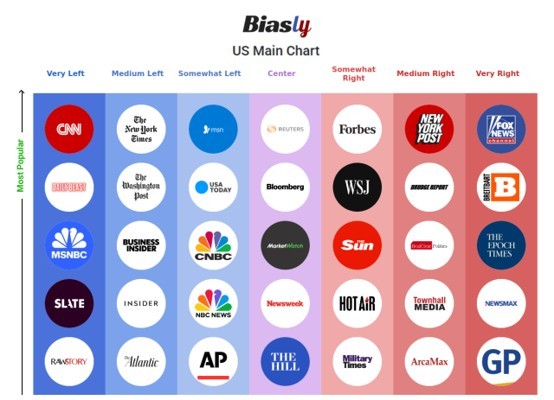
The chart helps readers visualize these distinctions.
Instead of reducing news organizations to simplistic labels, it encourages more nuanced evaluation. Readers can compare outlets, examine their relative positions, and explore the deeper source-level and article-level analysis that supports those ratings.
The goal is not to tell people what to think. It is to provide context that helps them think more critically.
By separating questions of bias from questions of reliability, the chart addresses one of the most common misconceptions in modern media consumption.
Questions to Ask Before Calling Something Fake News
When evaluating a news story, it helps to slow down and ask a few basic questions.
First, consider the evidence. Are claims supported by sources? Can the information be verified independently? Are experts, documents, or primary sources cited?
Next, examine the framing. Does the article rely heavily on emotional language? Does it present multiple perspectives? Does it omit important context that appears elsewhere?
Finally, compare coverage across multiple outlets. Reading different perspectives on the same event often reveals where interpretation begins and where factual agreement remains consistent.
These habits do not eliminate uncertainty, but they make it much easier to distinguish between biased reporting and outright falsehood.
Why Media Literacy Requires Both Skills
Fact-checking alone is not enough.
An article can be completely factual while still framing an issue in a way that influences perception. Similarly, understanding bias does not guarantee that every factual claim is accurate.
Effective media literacy requires both forms of evaluation.
Readers need to assess whether information is true. They also need to understand how that information is being presented.
One skill addresses accuracy. The other addresses the perspective.
Together, they create a more complete understanding of the news.
Understanding the Difference Makes You a Better News Consumer
Media bias and fake news are often discussed together, but they represent different challenges.
Media bias shapes how stories are told. Fake news shapes whether those stories are true.
Confusing the two can make it harder to evaluate information effectively. It can lead readers to dismiss legitimate journalism because they dislike its perspective, while overlooking unreliable content that confirms their existing beliefs.
The goal is not to find news that is completely free from perspective. That standard is unrealistic. The goal is to recognize perspective, account for it, and evaluate information accordingly.
Tools like Biasly's Media Bias Chart help support that process by giving readers a clearer picture of how bias and reliability interact. Combined with healthy skepticism, source comparison, and media literacy skills, that understanding can help readers navigate an increasingly complex information environment.
The result is not perfect certainty.
It is a better judgment. And in today's media landscape, better judgment is one of the most valuable tools a reader can have.

What's your reaction?
You may also like
-

Why Small Roofing Problems Can Become Harder to Diagnose When Homeowners Delay Repairs
-
Planning a Stair Lift for Shared Homes Without Disrupting Everyday Staircase Use
-
Managing Household Waste During Large Decluttering Projects Without Creating New Clutter
-
How to Plan Impact Door Installation Around Security, Access, and Everyday Household Routines
-
How Commercial Roofing Maintenance Planning Helps Property Managers Track Roof Conditions
-
Designing Privacy Around Street-Facing Windows Without Giving Up Useful Natural Daylight















Comments
0 comment