




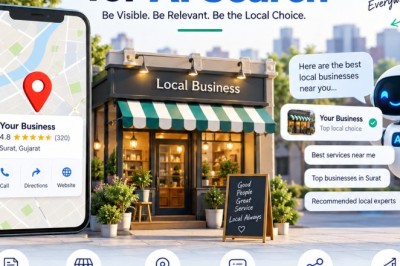
A customer types "best bakery near me open right now" into ChatGPT instead of Google. An AI model answers with three names. Is yours one of them? That's the whole game now, and most local business owners have no idea how it's being decided.
This isn't about chasing another algorithm update. It's a genuinely different way search works, and it rewards different things than the SEO playbook most of us grew up with. Here's how to actually optimize for it, step by step, without the fluff.
Start by understanding what AI search is pulling from
AI tools like ChatGPT, Perplexity, and Google's AI Overviews aren't crawling the live web every time someone asks a question. Most of the time they're combining a few sources: their training data, a real-time search of the web, business listing data, and review platforms. When someone asks about a local business, the model is essentially trying to answer with the most trustworthy, well-documented option it can find.
That word, trustworthy, does a lot of work here. A model has no way to personally vouch for your bakery. It can only lean on signals that suggest reliability: consistent information, real reviews, clear details about what you actually offer. If those signals are missing or contradictory, you get skipped, even if you're objectively the best bakery in town.
Fix your business information everywhere it appears
This sounds boring, and honestly it is, but it's also the foundation everything else sits on. Your business name, address, and phone number need to match exactly across your website, your Google Business Profile, Yelp, Facebook, and every directory you're listed in. Not close enough. Exact.
Why does this matter so much to a language model specifically? Because inconsistency reads as a red flag. If your address says "123 Main St" on one site and "123 Main Street, Suite B" on another, a model can't confidently confirm you're a real, stable business. Multiply that confusion across dozens of directories and you can see why some businesses just never get mentioned.
Set aside an afternoon, pull up every listing you can find, and fix the mismatches. It's tedious. It also works.
Add structured data your site is probably missing
Schema markup is code added to your website that explains, in a format machines can read, exactly what your business is, where it's located, what hours you keep, and what people are saying about you. Most small business websites don't have it, or have it half-implemented from a template years ago.
LocalBusiness schema, review schema, and FAQ schema are the three that matter most here. They don't change what a visitor sees on the page. They change what an AI model can confidently extract from it. Think of it as translating your website into a language machines trust more than plain paragraphs.
If you or your web developer haven't touched this yet, it's genuinely one of the better uses of a few hours right now.
Treat your Google Business Profile like a second website
A lot of business owners set up their Google Business Profile once and never touch it again. That's a mistake in the AI search era. For local queries specifically, GBP data often gets pulled into AI answers more directly than the content on your actual website.
Fill out every category and attribute. Post updates when something changes, a new menu item, a holiday closure, a seasonal offer. Answer the questions people leave in the Q&A section instead of letting them sit unanswered for months. None of this takes long, but it signals to both Google and the AI systems pulling from Google's data that your business is active and current.
Write content that actually answers something
Here's a pattern worth noticing: AI models tend to quote specific, concrete sentences, not vague marketing language. "We're committed to excellent customer service" gives a model nothing to work with. "We offer free estimates and typically respond to calls within two hours" gives it something it can actually repeat to a customer.
Go through your service pages and FAQ section and rewrite anything that sounds like it could apply to literally any business in your industry. Replace it with the specific thing that's true about you. Your actual hours. Your actual service radius. The actual price range for your most common job. Specificity is what gets cited.
Collect reviews that say something
Star ratings alone don't tell an AI model much. What helps is the actual text of a review, because language models read that text and pull details out of it. A review that says "fixed my AC same day and didn't try to upsell me on anything" is far more useful to a model than five stars with no comment.
When you ask customers for reviews, it's worth gently encouraging a sentence or two about what specifically they liked. You don't need to script it for them. Just asking "what stood out to you?" instead of only asking for a star rating tends to produce reviews with more of this useful, quotable detail.
Don't abandon the fundamentals
It's tempting to treat AI search as some separate, futuristic discipline that requires starting from scratch. It doesn't. Everything above overlaps heavily with solid, old-fashioned local SEO. A business that's already investing in Local SEO Services, keeping listings accurate, building genuine reviews, optimizing for neighborhood and city-level searches, is doing most of the groundwork AI visibility depends on. The two aren't in competition. AI tools are just synthesizing the same signals local search has relied on for years and presenting them differently.
What a realistic timeline looks like
This isn't a switch you flip. Cleaning up your listings and adding schema can happen within a week or two if you sit down and focus. Seeing that work translate into actual AI mentions usually takes longer, often a month or two, sometimes more in a crowded category.
The businesses that show up in AI answers a year from now will mostly be the ones that started fixing this stuff now, while a lot of local competitors are still treating it as someone else's problem. It's not complicated work. It's just work most people haven't gotten around to yet.
Local SEO Services is a results-driven digital marketing agency specializing in Local SEO, Technical SEO, Google Business Profile optimization, content marketing, and link building. We help businesses improve their online visibility, rank higher in local search results, and generate qualified leads through data-driven SEO strategies. Our team works with businesses across multiple industries to build sustainable organic growth and long-term search engine success. Learn more at Local SEO Services

What's your reaction?
You may also like
-

A Guide to Different Types of Health Apps
-
Early Signs of Cataracts You Should Not Ignore
-
7 Essential Urgent Care Tips for Kids – Open Near Me Today
-
Practical Strategies for Building a More Successful Retail Business
-
Does SnapTrader AI Work? A Clear and Honest Answer
-
7 Ways Real-Time Weather Updates Improve Customer Satisfaction












Comments
0 comment