




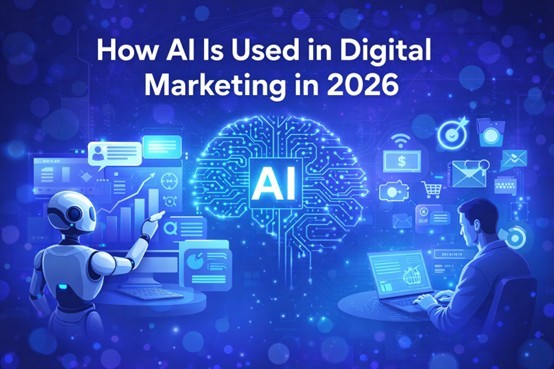
AI in Digital Marketing
Introduction
In 2026, artificial intelligence has transitioned from being a “nice-to-have” to an everyday part of marketing teams. AI now operates in every aspect of digital marketing, rather than just as a writer's assistant or smart bid tool; it has become ingrained in every part of the marketing stack — customer data platform (CDP), creative production/measurement, and attribution/full funnel automation.
For marketing teams and business leaders, this means new ways to achieve increased levels of personalized marketing at scale, faster campaign lifecycle times, and an increased measurable ROI, along with new governance obligations, talent acquisition, and ethical obligations.
In addition to providing the key trends impacting AI in digital marketing in 2026, the article will look at the essential tools available, provide concrete examples of AI use within a digital marketing team, and look at Agency Glorywebs’ AI Automation Services and AI-powered digital marketing services, and how these will provide measurable results for Clients.
Key Trends in 2026
1. Predictive, agentic workflows replace reactive optimization
The marketing industry is moving away from manual reactive optimisation (i.e after a campaign has been launched, optimising it) to predictive planning and using agentic AI that can complete complex tasks with very little human involvement (in other words, if the person in charge of the team wants to sit on the sidelines and allow AI to do everything).
The operating models of teams (how they are organised and how they verify AI outputs) are now the most significant determining factor in who realises the most value from artificial intelligence implementations, and numerous large surveys have established that businesses that have clear processes for these areas receive the greatest benefit from AI implementations.
2. Personalization at scale becomes table-stakes
Customers want to have personalised experiences based on their unique context, not just through standardised emails. The use of AI for individuals has also allowed for the development of dynamic creatives (designs created based upon current conditions at any point in time, such as dynamically changing images of products), product recommendations, site journeys, and email content, all generating different outputs in response to first-party signals, in real-time.
Both enterprise and vendor platforms offer predictive modelling of the next best action to deliver the correct message at the right time. The Adobe and other vendor documents identified personalisation as a primary growth lever for 2025 and beyond.
3. Automation moves beyond rules to fully automated creative-to-audience flows
Across all major commercial platforms, all currently developing solutions to provide automatic input (product assets, goals, and budgets) will allow the platform to recommend or generate variants of advertisements (creative images), target audiences, and prepare budgets, all automatically, from their own systems.
Meta has expressed an intent to automate a significant number of traditional methods associated with advertisement creation and targeting (which is a shift away from a human-focused process), and, as a consequence of this automation, Meta is also making it easier to scale advertisement buys through the use of traditional social media channels.
The speed of execution through this type of automated solution is much faster, but companies still must implement and follow clear-brand guardrails, as well as oversight by people, associated with how their advertisements are marketed through social media platforms.
4. Generative media becomes part of the standard creative toolkit
AI-created video content, synthetic voice-overs, and automatically generated images have now become the standard way of creating promotional materials for products (and other items), as well as localised advertisements (i.e., advertisements designed specifically for a specific region), and the formation of campaigns across social media platforms.
Teams may now combine the creation of visual direction (of a person or team) with AI-generated "roughs" and adaptations of advertisements for each specific market, to quickly and efficiently create high-quality promotional campaigns for products without the need to use ever-increasingly expensive shooting facilities.
5. Measurement & attribution get smarter — and more complex
The changes associated with the cookie deprecation process and increasing requirements for privacy, in combination with the impact of AI on measuring marketing performance, have resulted in marketers increasingly relying upon first-party data, probabilistic models, and AI-based attributions to accurately assess and report on marketing performance.
The combination of model-based measures and counterfactual methods allows marketers to more accurately assess incremental builds than through last-click attribution models.
Top Tools & Platforms (what teams are using in 2026)
The modern marketing technology stack for marketers is made up of a combination of Enterprise Platforms and Specialized in-house solutions, as well as startup solutions. The following is an overview of the categories of these Tools and Platforms, and at least one example of Tools commonly used by marketers:
- Enterprise Marketing Clouds and Customer Data Platforms (CDP's) - Salesforce Marketing Cloud (Einstein), Adobe Experience Cloud (Sensei), HubSpot (AI Agents) - These Tools allow marketers to orchestrate, predictively score, and activate their marketing campaigns through multiple channels.
- AI Creatives and Video Generation - Synthesia, Runway, and other specialized studios for creating localized, avatar-based, and B-Roll materials. These Tools are typically used to create explainer videos, product promotions, and content that is multilingual.
- Programmatic and Optimization Layers - Demand Side Platforms (DSP's) and Predictive platforms that are able to learn in-flight and to automatically reallocate advertising budget based on performance signals and predictions of Return on investment (ROI). Most common vendors have incorporated first-party data natively into their tools.
- Search and Discovery Assistants - Tools that combine Intent Modelling (Understanding and gathering data on the intent of users) with Creative Generation (Creating advertisements for Search Engines and Discovery-based Retail environments) to deliver enriched search experiences to consumers.
- Measurement and Attribution - AI-Driven Incrementality (understanding how much of a conversion is driven by a specific campaign) platforms and Model-Based Attribution tools are designed to work with Privacy First Data.
When it comes to the Tools and Platforms that a Marketer chooses to work with, Interoperability (through Application Programming Interfaces (API) and integrating with a CDP), Transparent Model Behaviors (through Audit logs and Human Review), and Vendor Policies Regarding data usage and Intellectual Property/Licensing will be important considerations.
Real-World Use Cases (actionable examples)
1. Hyper-localized creative and distribution
Use case: A shoe company wants its holiday ad campaign to be in twelve different countries at once.
How AI helps:
- Create several versions of the main creative concept for each of the twelve countries (ie, regional images, product line, etc).
- Conduct pre-testing of creatives with 'A/B' style systems to find out which ones perform best.
- Automatically deploy the winning creatives on Connected TV, social media sites, and Display with a real-time allocation of ad spend.
Result: A shorter time to market and lower production cost for producing your creatives, as well as a measurable increase in Engagement levels when compared to using traditional methods.
2. Automated lead qualification + predictive nurturing
Use case: Business-to-Business (B2B) Software as a Service (SaaS) that has a long and complex sales cycle.
How AI helps:
- AI Automation Solutions collect leads through Chat or Forms, score them by using predictive likelihood models, and start the process of individualised nurturing.
- They will also integrate with your Sales Customer Relationship Management (CRM) platform and automate the process of scheduling appointments and notifying you about high-intent accounts.
Result: Reduced Sales Development Representatives (SDR) time wasted on poor quality leads that won't convert to sales and improved the speed of qualifying sales and leads (SQL).
3. Creative iteration at scale for paid social
Use case: DTC eCommerce brand requires numerous ad variants.
How AI helps:
- AI combines data from a business's product catalog and utilizes generative video and copy templates to create hundreds of advertisements.
- Performance-based automated pruning retains only the highest-performing advertisements, while automatically pausing underperforming advertisements.
Result: Rapid development of creative assets leads to improved ROAS and decreased creative development expenses.
4. Content operations & knowledge reuse
Use case: Global Company A is interested in producing a regular stream of thought leadership material from each of its locations.
How AI helps:
- A Centralized Knowledge Model (adapted for Branding Content - brand authority, message, tone, and voice) creates outlines, drafts, and SEO Optimized Articles.
- Human Editors refine and localize for tone of voice, while maintaining the Brand Consistency and reducing the writer hours required.
Result: Scaled Content Production with uniformity of Quality and an increase in Organic Traffic.
Governance, Ethics, and Practical Guardrails
Power and risk are present when AI is used for marketing. To mitigate the risks, marketers should have several operational guidelines in place:
- Human-in-the-loop (HITL): Access must be incorporated into all brand-facing AI outputs before they go live. All forms of creative and legal writing must be reviewed by a person before deployment.
- Data Privacy: Consent needs to be taken into consideration for all first-party data used. Marketers can implement a mapping system that identifies where all data comes from and what regulations it complies with, such as GDPR/CCPA, etc.
- Explanation and Audit Log: The audit process tracks everything the model does and links the data collected with the money spent or the target being targeted.
- Copyright and Intellectual Property Rights: Marketers should know their rights to use the materials used to train the AI model and the content created through AI. Any vendor that offers their own datasets or consent processes should be the preferred choice for marketers using AI.
These guidelines protect the company's brand while allowing it to grow its business and take advantage of increases in productivity from AI.
How Glorywebs Helps
Glorywebs offers AI Automation Services and AI-powered Digital Marketing Services built specifically for SMEs and Growth Stage companies. We convert your business's needs into applicable AI technologies as quickly as possible.
- Assessment and Roadmap: We evaluate your organization's data and martech stack (technology stack of marketing), then align the key use cases based on Priority for both short and long-term goals. For example, automation of personalized email marketing could be an example of a short-term win, while the investment in Customer Data Platforms (CDPs) and model governance would be examples of longer-term investments.
- Implementation and Integration: Our team implements CDPs, connects first-party data sources to the CDPs via API, and connects the CDP solution to the Advertising Platforms and Analytics Solutions (i.e., Google Analytics) so that the Models will receive the same/similar signals throughout their lifecycles as well as from all data sources.
- Creative and Production: Our creative and production teams leverage our AI-enabled creative workflows to automate many of the tasks normally performed by humans (e.g., copy generation, AI-generated videos, automated translation, etc.), providing customers with the ability to produce the same amount of content as quickly as a human, while ensuring brand consistency, tone, and compliance.
- AI Automation Services for Campaign Operations: Our team builds agentic workflows to assist customers in managing their campaigns' bids, creatives, and audiences. Each workflow will have the necessary human oversight and security measures to ensure customers have the speed that automation provides without sacrificing control over the brand.
- Measurement and Optimization: Our team implements model-based attributions, incrementally-tested dashboards, and calculates true ROI for our customers so they can see how AI-based campaign decisions impact their businesses.
- Case Study Highlight: For a mid-sized retail client, Glorywebs used a combination of the client’s first-party CRM and our platform to optimize their programmatic purchases of products and to deliver AI-generated video product demonstrations on localized landing pages. In the first 90 days after the implementation, the client had reduced their CPA by 28% while also increasing localized landing page conversion rates.
Pragmatic adoption is at the heart of our approach; we will help our customers choose which use cases will work best for them and help them to protect their brand and privacy before scaling. If desired, we can build a 60-90 day pilot that delivers measurable results of a specific KPI (e.g., CPL, AOV, or SQL conversion rate) by combining automation and bespoke creative products.
Actionable Steps for Marketing Leaders (quick checklist)
- Take stock of the sources of data you have available to use and confirm the readiness of your data feeds (first-party data).
- Identify 1-2 key usages of AI to give you the most value (for example, email campaigns throughout the customer journey or automated advertising creative) and conduct brief pilot testing of these destinations.
- Ensure that all third-party AI model implementations provide detailed information on how the model was trained, including the provision of an audit trail of the models created and used.
- Create a standard operating procedure (SOP) for reviewing content with AI (who approves content, who determines what types of targets should receive content, and who sets the budget for each campaign).
- Create a separate research-and-development budget that is at least 4% of your current digital marketing budget to explore new ways to use AI to improve your overall digital marketing effectiveness (e.g., creating AI-generated short-form video, using interactive formats).
Future Outlook
In the near future, there will be more widespread automation across social media channels; there will be greater integration of generative content with the automated buying process; there will also be a growing marketplace for artificial intelligence (AI) that can coordinate and execute multi-touchpoint campaign strategies; however, those who build automated programs will most likely require that agencies follow the laws of governance and ethical standards with respect to their customers and industry best practices with respect to the management of data to be able to profit from such platforms. Finally, the future of platforms will involve a combination of transparency, privacy settings, and the ability to integrate with data stored by businesses on their own systems.
Conclusion
The future of technology and digital marketing will see more use of artificial intelligence for the organisation of processes for faster delivery and greater visibility of results. Tools previously used for tactical functions in the digital marketing space are now being used for strategic purposes through the application of technology such as extensive data, automation, Predictive Analysis, and Personalisation.
Technology combined with effective governance, a data-first approach, and skilled staff is essential to successfully harnessing the power of AI in digital marketing.
To see how you can effectively incorporate this technology and achieve the highest level of success possible through your marketing efforts, be sure to partner with a qualified vendor to manage your pilot project focused on one KPI. Glorywebs can help you architect, manage, connect, and scale the tools and processes to create and support success in this evolving area of Digital Marketing.

Author Name: Anil Parmar
Author Bio:
Anil Parmar is the CEO of Glorywebs with over 13+ years of experience in AI-powered software solutions and digital marketing. He drives business growth through innovative, customer-focused strategies and shares practical insights to help businesses succeed in today’s competitive landscape.

What's your reaction?
You may also like
-

Why Small Roofing Problems Can Become Harder to Diagnose When Homeowners Delay Repairs
-
Planning a Stair Lift for Shared Homes Without Disrupting Everyday Staircase Use
-
Managing Household Waste During Large Decluttering Projects Without Creating New Clutter
-
How to Plan Impact Door Installation Around Security, Access, and Everyday Household Routines
-
How Commercial Roofing Maintenance Planning Helps Property Managers Track Roof Conditions
-
Designing Privacy Around Street-Facing Windows Without Giving Up Useful Natural Daylight
















Comments
0 comment