




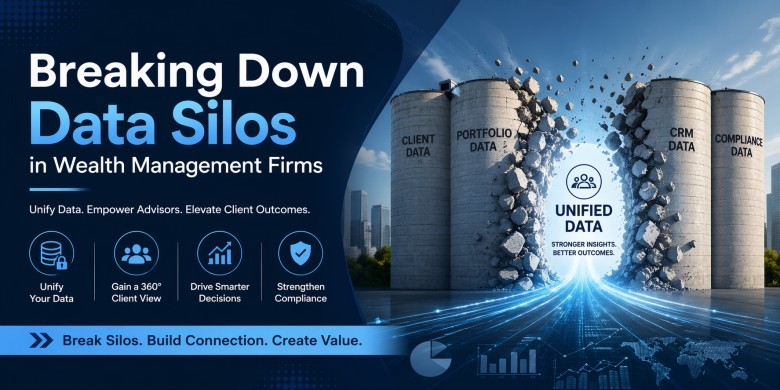
By 2026, wealth management firms will be operating in an environment that is more complicated, data-focused, and customer-driven than ever before. High-net-worth individuals want personalized financial advice in real time, regulatory frameworks are tightening, and digital transformation is not a nice-to-have anymore but a competitive imperative. However, despite throwing enormous amounts of money at fintech tools, firms still face an age-old challenge: data silos.
Data silos are isolated systems where information is stored and cannot able to communicate with other systems or process data. Meaning client portfolios, risk assessments, CRM data, tax records, and advisory insights are often isolated in wealth management silos. This leads to inefficient decision-making and lost opportunities for clients and advisors alike.
This is more than an IT upgrade; it is a strategic transformation to bring down these silos. Organizations that effectively put their data ecosystems together leapfrog their competitors by improving personalized interaction, enabling compliance, and driving operational efficiencies. This article looks at what are data silos, why they continue to exist in wealth management firms, and the implications of siloed data, and ways to eradicate them using modern technology, AI, and integrated data architecture.
Understanding Data Silos in Wealth Management
In wealth management, data silos are isolated databases of financial and client information that cannot easily be shared by departments, systems, or platforms. An investment advisor, for example, uses a system to keep track of their portfolios, the compliance team another to report regulatory matters, and the CRM team maintains an independent log of client interactions.
This fragmentation creates an environment in which no one team has a holistic or real-time view of the client. Rather than providing a holistic view of the firm, firms tend to work with fragmented knowledge.
In practice, this leads to:
- Duplicate data entry across systems
- Inconsistent client records
- Delayed reporting and analysis
- Poor cross-department collaboration
In the present-day world of wealth management, where decisions need to be backed by data and made based on near-instantaneous insights, silos become invisible roadblocks that hinder growth as well as innovation.
Why Data Silos Are a Bigger Problem in 2026
Wealth management firms are contending with exponential data growth in 2026. Clients are creating financial footprints that span traditional investments along with crypto assets, ESG portfolios, offshore accounts, and digital banking tools.
Simultaneously, firms are steadily utilizing cutting-edge technology such as AI-based advisory systems and Predictive analytics - Robo-advisors. But these systems are as good as the data they are fed.
Here are a few reasons why Data silos is particularly harmful these days:
1. Real-time expectations
And clients expect insights into their portfolios in real time. The more fragmented the systems, the greater the delay in delivering data; every delay erodes trust.
2. Multi-asset complexity
Everything — from stocks and bonds to bitcoin or other digital coins — needs to be tracked as a single portfolio even though modern portfolios include traditional assets, digital assets, and alternative investments.
3. Regulatory pressure
Compliance frameworks now require reporting that is transparent, auditable, and centralized.
4. AI dependency
When the data is insufficient or inconsistent, machine learning models do not work.
5. Client personalization
Because integrations are broken (or not happening), silos prevent ever achieving a 360-degree view of the client that is necessary for hyper-personalized advisory services.
Even the other end of seemingly unrelated digital ecosystems—like those integrations in client experience platforms using tools like google maps prestashop—illustrate how modern systems are moving from containerized applications to a world where data is always flowing rather than confined inside an instance of an application.
Key Causes of Data Silos in Wealth Management Firms
Although everyone undoubtedly knows this problem, silos exist for structural, cultural, and technological reasons.
1. Legacy Systems
Numerous wealth management companies remain on legacy platforms built decades prior. These systems were not built with interoperability in mind, and lack appropriate APIs or modern integrability features.
2. Departmental Separation
Advisory, compliance, risk, and operations teams have different specialized tools built for their particular workflows. Each can be efficient in its own right, and they seldom speak to each other effectively.
3. Mergers and Acquisitions
The process leaves a company inheriting one or more incompatible systems when companies merge. Most organizations do not consolidate them but stack new ones on top of existing ones, thus aggravating fragmentation.
4. Data Ownership Culture
In some organizations, departments “own” their data and are reluctant to share it for fear of losing control or accountability.
5. Lack of Integration Strategy
As a result, firms pick and choose tools without a long-term plan for data architectures. This results in a mishmash of disparate technologies.
The Impact of Data Silos on Wealth Management
The impact of data silos transcends not only profit margin, customer satisfaction, and operational efficiency.
1. Poor Client Experience
Advisors who do not have complete client portfolio visibility may deliver incomplete/inconsistent guidance. This is something clients catch on to very quickly, which does not help their trust and satisfaction.
2. Inefficient Operations
Employees spend a lot of time on reconciling data across systems instead of value-adding strategy and advisory work.
3. Increased Compliance Risk
From scattered data comes error-prone regulatory reporting, leading to nasty penalties and audits.
4. Missed Revenue Opportunities
If insights are not integrated, then the firms might end up overlooking cross-sell or upsell opportunities or miss out on serving their customers better.
5. Slower Decision-Making
Executives are shuttled through static BI instead of real-time dashboards and are forced to make strategic decisions long after the event has occurred.
6. AI and Analytics Limitations
Clean, integrated datasets are critical for predictive models and investment algorithms. Silos degrade model accuracy significantly.
Strategies to Break Down Data Silos
Breaking down data silos takes both tech solutions, governance, and a cultural shift. The following are the most important actions that wealth management firms should take over the course of 2026.
1. Build a Unified Data Architecture
A centralized data architecture, typically powered by cloud data warehouses or data lakes, serves as the bedrock for silo elimination. That is what guarantees that every system aggregates into a single source of truth.
2. API-First Integration Strategy
Wealth management platforms of the future will need to embrace API-first design principles; an innovative architecture that enables seamless communication between CRM, portfolio management, compliance, and analytics tools.
3. Implement Data Governance Frameworks
Data governance ensures data is consistent, of high quality, and that its ownership is clear. This includes:
● Standardized data definitions
● Role-based access control
● Data validation rules
4. Adopt Real-Time Data Streaming
Redirect firms from batch processing to real-time data pipelines. This means that updates on information to all systems are instant, meaning a more responsive environment.
5. Use AI-Powered Data Unification
Using AI tools to automatically detect duplicate records, normalize datasets, and connect broken client profiles
6. Cross-Department Collaboration
Technology alone is not enough. Organizations should promote inter-departmental collaboration through shared dashboards and integrated workflows.
Role of AI, Cloud, and Modern APIs
Three key innovations stand at the center of this technological backbone to break data silos: AI, cloud computing, and APIs.
● Artificial Intelligence
AI helps in:
● Data cleansing and normalization
● Predictive client behavior analysis
● Automated reporting
● Fraud detection across fragmented systems
● Cloud Computing
Cloud platforms enable:
● Centralized data storage
● Scalable infrastructure
● Advisors and clients granted access anywhere in the world
● Easier integration of third-party tools
● APIs and Microservices
APIs serve as the connectors between systems, enabling smooth communication. Microservices architecture allows each of the functions (risk analysis, portfolio tracking, and so on) to run in its own way, with data sharing between them.
Some modern digital ecosystems, for example, mapping client interactions or physical advisory locations using tools similar to google maps prestashop— showcase how even non-requisite integrations are possible via APIs, giving freedom to create a simple yet powerful experience layer that can be wrapped around multiple existing systems.
Practical Roadmap for Wealth Management Firms
It is not going to happen overnight, breaking down data silos. It requires a structured roadmap.
Phase 1: Assessment
● Identify all existing data sources
● Map system dependencies
● Detect redundancy and duplication
Phase 2: Strategy Design
● Define a unified data architecture
● Choose cloud and integration tools
● Establish governance policies
Phase 3: Integration
● Deploy APIs and middleware
● Transfer legacy data into centralized systems.
● Implement real-time data pipelines
Phase 4: Optimization
● Introduce AI-driven analytics
● Automate reporting processes
● Continuously refine data quality
Phase 5: Cultural Transformation
● Train employees on new systems
● Encourage cross-functional collaboration
● Promote a data-sharing culture across departments
Future Outlook: A Unified Wealth Management Ecosystem
A combination of fully integrated digital ecosystems in the wealth management industry is on its way by 2026 and beyond. Firms that will succeed will be those that obliterate silos and operate within one data intelligence layer.
In this future:
● Advisor will have instant access to full client profiles
● AI will generate real-time investment recommendations
● The automated aspect of compliance reporting
● Customers will be offered an integrated omnichannel financial service
Converting to a single voice of intelligence from broken systems is not just technology but, business transformation.
Conclusion
One of the major impediments hindering effectiveness and expansion at wealth management institutions is siloed data. Although technology has progressed by leaps and bounds, organizational structures and legacy systems have had a tougher time being nimble.
Still, the way forward seems simple enough. A seamless integration of custom web interfaces, unified data architectures, and embedded analytics would empower wealth management firms to break down the silos that have constrained their growth for so long — turning them into profit engines.
Data integration is an imperative — no longer optional, but the very key to competitive advantage in a world where financial decisions must be one step faster, smarter, and more personalized.

What's your reaction?
You may also like
-

Why Small Roofing Problems Can Become Harder to Diagnose When Homeowners Delay Repairs
-
Planning a Stair Lift for Shared Homes Without Disrupting Everyday Staircase Use
-
Managing Household Waste During Large Decluttering Projects Without Creating New Clutter
-
How to Plan Impact Door Installation Around Security, Access, and Everyday Household Routines
-
How Commercial Roofing Maintenance Planning Helps Property Managers Track Roof Conditions
-
Designing Privacy Around Street-Facing Windows Without Giving Up Useful Natural Daylight











Comments
0 comment