




Updated November 2026
For a first cloud engagement, start with a firm that reviews your configuration before it attacks, then bring in deeper attack specialists once the obvious problems are fixed. Cloud Security Partners is best overall for cloud-native teams starting with a cloud security assessment. Rhino Security Labs leads on AWS attack research, Bishop Fox builds tests around business objectives, and Atredis, Schellman, GuidePoint and Software Secured suit Kubernetes-heavy estates, SOC 2 timing, detection testing and audit evidence.
That order matters because cloud breaches rarely start with an exotic exploit. They start with a storage bucket left public, an access key committed to a repository, or a role that can do far more than its job requires, and then chain those small mistakes together until someone reaches customer data. A good cloud penetration test finds that chain before an attacker does. This guide compares seven firms, then explains the three decisions that shape any cloud engagement: assess or attack first, where testers start, and which provider rules apply.
Seven cloud penetration testing companies at a glance
|
Company |
Best for |
What sets it apart |
|
Cloud Security Partners |
Cloud-native teams starting with a cloud security assessment |
200+ validations across AWS, Azure and GCP, with quarterly differentials |
|
Rhino Security Labs |
Deep AWS attack research |
Built Pacu, the open-source AWS exploitation framework |
|
Bishop Fox |
Objective-based cloud attacks |
Tests built around a compromised app, a malicious user or a custom goal |
|
Atredis Partners |
Kubernetes and pipeline-heavy estates |
Clusters, CI/CD and infrastructure code in scope |
|
Schellman |
Pairing a test with SOC 2 |
Seeded users that mimic an employee, a developer or a read-only account |
|
GuidePoint Security |
Testing detection as well as defenses |
Cloud specialists paired with an attack simulation team |
|
Software Secured |
Startups that need audit-ready evidence |
Read-only review with control mappings and redacted customer reports |
1. Cloud Security Partners: Best overall for cloud-native teams starting with a cloud security assessment
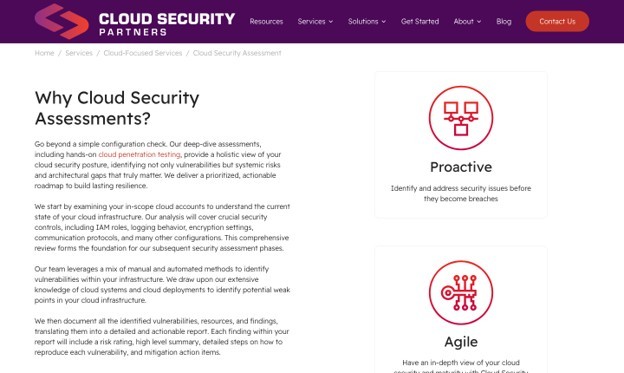
Cloud Security Partners' cloud assessment service. Image: Cloud Security Partners
Cloud Security Partners starts with your in-scope accounts, covering IAM, logging, encryption and public infrastructure, then moves to hands-on testing. Its cloud security assessment runs more than 200 validations across AWS, Azure and GCP, maps findings to CIS, NIST and CSA, and gives each finding a risk rating, reproduction steps and a fix. Quarterly testing reports new and remediated findings.
2. Rhino Security Labs: Best for deep AWS attack research
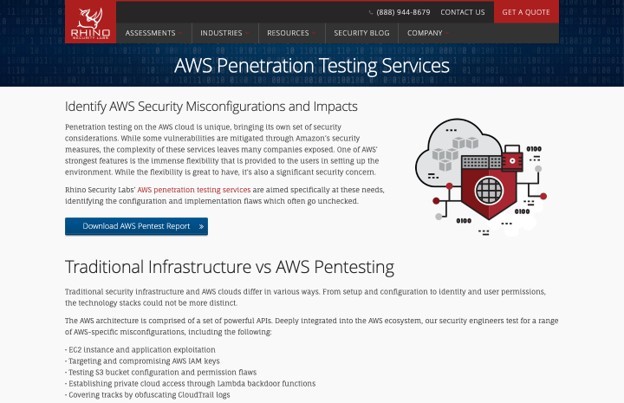
Rhino Security Labs' AWS testing service. Image: Rhino Security Labs
Rhino Security Labs built Pacu, the open-source AWS exploitation framework many cloud testers use. Its AWS assessments start from a console account you provide and probe IAM key compromise, S3 permission flaws, EC2 exploitation, Lambda backdoors and attempts to hide activity from CloudTrail. It also tests Azure and Google Cloud, and suits a team that has cleaned up its configuration and wants to know what a skilled attacker could still do.
3. Bishop Fox: Best for objective-based cloud attacks
Bishop Fox builds each test around a goal you choose: a compromised application or service, a malicious user, or a custom scenario. It combines configuration review with real exploitation across AWS, Google Cloud and Azure, ranks findings by how likely they are to be exploited, scores impact using OWASP and CVSS, and writes separate reports for executives and engineers. It suits larger companies that want cloud findings ranked by business impact rather than by benchmark section.
4. Atredis Partners: Best for Kubernetes and pipeline-heavy estates
Atredis traces attack paths from IAM escalation to container escape to compromise of the build pipeline. It covers Kubernetes control planes and RBAC, CI/CD on GitHub, GitLab, Azure DevOps and Bitbucket, and infrastructure code in Terraform, CloudFormation and Helm. Supply chain work is guided by SLSA, and engagements can start from one of five positions, with objectives as specific as turning repository read access into write access. It suits platform teams whose real risk sits in clusters and pipelines rather than in console settings.
5. Schellman: Best for pairing a test with SOC 2
Schellman tests AWS, Google Cloud, Azure and Oracle Cloud from seeded users and API keys that mimic a standard employee, a developer or a read-only account, then looks for privilege escalation through compute, storage, identity and serverless services, which shows what a realistic insider could reach. Because it also performs SOC 2 examinations, testing and audit can share one calendar; ask how the two teams are kept independent.
6. GuidePoint Security: Best for testing detection as well as defenses
GuidePoint pairs cloud security specialists with its attack simulation team, so a test checks whether your monitoring notices the attack as well as whether the attack works. Reports cover resiliency, monitoring coverage and detection efficacy, findings arrive with both the exploit and the configuration fix, and a follow-up validation confirms remediation. It suits organizations with a security operations team that wants cloud attacks reflected in its alerting.
7. Software Secured: Best for startups that need audit-ready evidence
Software Secured's cloud review covers identities, network boundaries, storage, key management, backups and logging across AWS, Azure and GCP through read-only audit roles and a scoped bastion session. Findings map to compliance controls, export to Jira or Azure DevOps, and come with redacted reports for customers. Its portal connects to Vanta and Drata, which helps a startup preparing for its first audit.
Should you assess first or attack first?
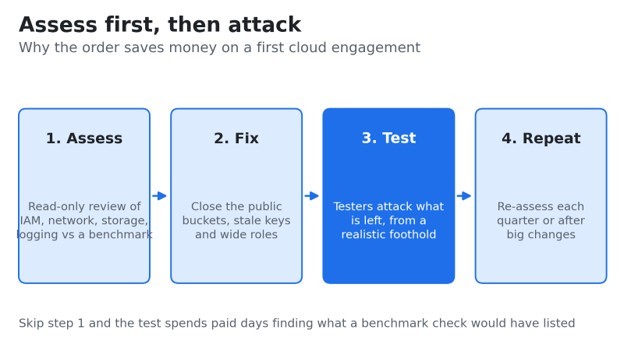
The order that gets the most from a first engagement. Our diagram.
A cloud security assessment reads your configuration from the inside with read-only access; a cloud penetration test attacks it from a foothold. If you have never had either, assess first. A test run before any assessment spends paid days finding public storage, stale keys and over-broad roles that a benchmark check, such as the CIS Benchmarks for each cloud provider, would list far sooner. Fix those, then bring in attackers to find what a checklist cannot: the chain of small permissions that turns one stolen key into access to customer data.
Where should the testers start?
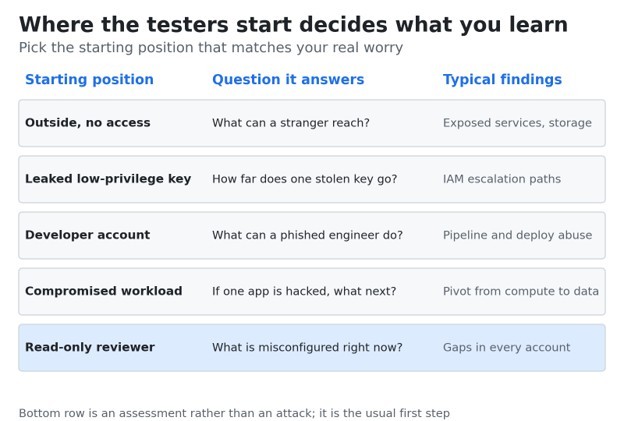
Match the starting position to your real worry. Our diagram.
Two firms can both sell a "cloud pentest" and answer different questions, because their testers start in different places. A test with no access tells you what a stranger can reach from the internet. A test from a leaked low-privilege key tells you how far one mistake goes, which is usually the more useful answer. A test from a developer's identity tells you what an insider or a compromised laptop could do. Ask every firm to name its starting position in the proposal.
Which provider rules apply?
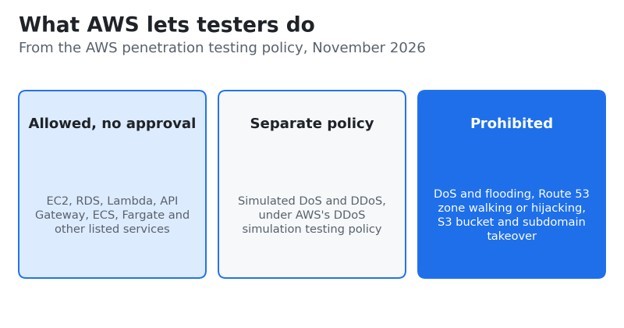
Summary of the AWS testing policy. Our diagram.
Cloud providers set their own rules for testing what you rent from them. AWS's penetration testing policy lets customers test listed services such as EC2, RDS and Lambda without prior approval, requires approval for some activities, and prohibits denial of service and attacks on AWS's own infrastructure. Azure and Google Cloud publish rules of their own. A good proposal names the rules for each cloud in scope, and explains how the firm will describe a risk it is not allowed to demonstrate.
How to scope a cloud test
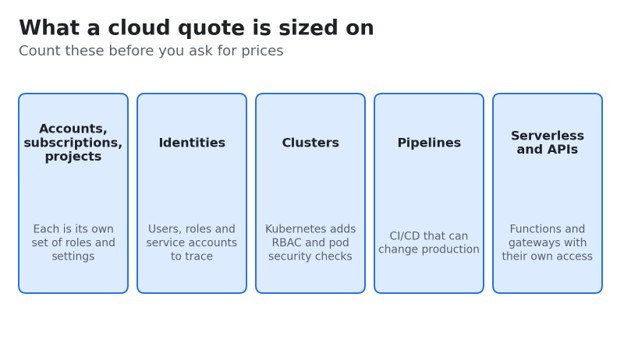
The inventory that drives a cloud proposal. Our diagram.
Cloud tests are scoped by what has to be traced, not by IP addresses. Before asking for proposals, count your accounts or subscriptions, the identities and roles in them, Kubernetes clusters, pipelines that can change production, and serverless functions and APIs. Give every firm the same inventory and starting position, and ask for the number of testing days, the testers' names and the retest terms, so proposals can be compared like for like.
What a useful cloud finding looks like
A cloud report is only as good as its worst-written finding, so ask for a redacted sample before you sign. A finding an engineer can act on has six parts:
1. The resource, named precisely: account, region, role or bucket.
2. The path, step by step, from the starting position to the impact, so the chain is clear rather than a list of separate settings.
3. The proof, such as the command run and what it returned, within the provider's rules.
4. The impact in business terms: which data or systems an attacker would reach.
5. The fix, ideally as the exact policy change or infrastructure code edit.
6. The retest status, so the finding can later be shown as closed to customers and auditors.
Findings written this way can go straight into a ticket. Findings that only cite a benchmark section number usually need a second meeting to explain.
Bottom line by situation
● First cloud engagement, cloud-native product: begin with a configuration-led assessment, then test.
● Mature AWS estate, configuration already clean: choose a firm with deep AWS attack research.
● Board wants impact, not settings: pick an objective-based test.
● Kubernetes and pipelines are the crown jewels: make sure clusters and CI/CD are in scope.
● SOC 2 this year: align the test with the audit period, from one firm or two.
● You run a security operations team: add detection testing.
FAQ
How long does a cloud penetration test take?
Most run one to three weeks of testing depending on the number of accounts, identities, clusters and pipelines, plus time for the report. A focused review of one account is quicker; multi-account estates with Kubernetes take longer.
What is the difference between a cloud security assessment and a cloud penetration test?
An assessment reviews configuration from the inside with read-only access and finds misconfigurations methodically. A penetration test attacks from a starting foothold to show how far an attacker could get. Most teams need both, assessment first.
Do we need permission from AWS, Azure or Google to test?
Usually not for common services, but each provider publishes rules on what may be tested and which activities need approval or are prohibited. Your testing firm should follow the rules for every cloud in scope.
What can a cloud penetration test not show?
It reflects the accounts, roles and starting position in scope during the test. Provider rules also limit proof, so some risks, such as a possible subdomain takeover, are described rather than demonstrated. Treat a described risk as seriously as a proven one.
How often should we test our cloud?
At least once a year and after major changes to accounts, identity or network design. Continuous configuration monitoring between tests catches drift that an annual test would miss.

What's your reaction?
You may also like
-

5 Proven American Dream Car Warranty Tips for Car Owners
-
You Inherited a Watch: What to Do Before You Sell It
-
Essentials Plumbing Maintenance That Requires a Professional
-
What to Look for in a Quality Prom Dress
-
5 Powerful Best Treatment for Burns That Heal Fast Guide
-
5 Ultimate American Dream Auto Protect Advantages Explained















Comments
0 comment