




A customer sends an urgent support request, a sales lead submits an inquiry, and a new order triggers a fraud warning. Each situation requires a decision, but the information often arrives as unstructured text. Employees must read the details, identify what matters, and decide what happens next.
Traditional AI chatbots can summarize messages or draft replies, but businesses often need something more specific: a clear answer that software can use immediately. This is where decision-focused AI becomes useful. Instead of generating lengthy explanations, it evaluates information against defined questions and returns structured results.
Jev AI is a decision-focused AI model designed to help businesses make faster, more structured decisions. Unlike traditional AI models that generate lengthy conversational responses, it analyzes information and provides clear outputs such as Yes/No answers, predefined choices, scores, and probabilities. This makes it particularly useful for tasks like customer support routing, lead qualification, risk assessment, and automated decision-making.
Start With a Decision, Not a Prompt
Before introducing AI into a workflow, identify the decision that needs to be made.
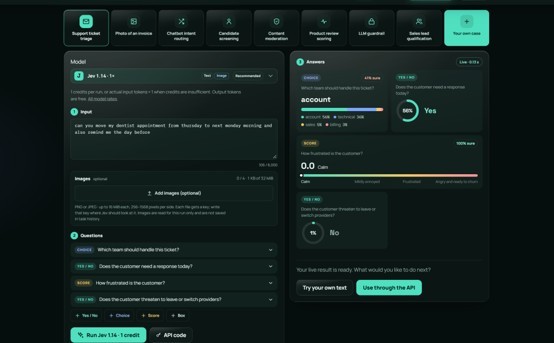
Consider an online retailer receiving hundreds of customer messages each day. Some concern delivery delays, others involve refunds, and a few describe urgent payment problems. A general-purpose chatbot might summarize every message, but employees still need to determine which department should handle it and how quickly someone should respond.
A more useful approach is to define three questions:
-
Which department should receive this request?
-
Does the customer need an urgent response?
-
How serious is the customer's frustration?
These questions produce actionable information. The first determines routing, the second supports prioritization, and the third helps the team understand customer sentiment.
The goal is not to replace human judgment. It is to reduce repetitive classification work while keeping uncertain cases visible.
Understand How Decision-Focused AI Works
Most people associate artificial intelligence with content generation. They expect a model to write an email, create an image, or answer a question in natural language.
Decision-focused models operate differently.
The Jev model uses a System One approach developed by TypeSafe AI. It evaluates supplied information and answers predefined questions using structured output formats.
Three question types are particularly useful.
Yes/No: Evaluate a Specific Condition
A business might ask whether a support request requires immediate attention.
Instead of generating a paragraph, the model returns a probability associated with a positive answer. Applications can use this result alongside business rules to determine the next step.
Choice: Select From Defined Options
A company can provide a list of departments such as Billing, Technical Support, and General Inquiries.
The model evaluates the message and selects from those predefined options. This helps keep automated routing consistent with the organization's existing workflow.
Score: Measure Against a Defined Scale
Businesses may need to assess customer frustration, sales lead quality, or content relevance.
A scoring question evaluates the input against a specified scale or rubric. The resulting score can support prioritization, reporting, or additional review.
These question types can also be combined in a single request, allowing one customer message to be evaluated from several perspectives.
Build a Practical Customer Support Workflow
Imagine a customer writes:
"My payment has failed three times, and I still cannot access my subscription. Please resolve this today."
A decision-focused workflow could evaluate the message and return a structured result identifying the responsible department, the likelihood of urgency, and a frustration score.
The application could then route the message to billing support, assign a priority level, and notify the appropriate employee.
However, the business should define its own rules before automating these actions.
For example, requests involving potential financial loss could always require human review, regardless of the model's confidence. Less sensitive requests might be automatically categorized when the result meets a tested confidence threshold.
This approach combines AI-assisted classification with organizational control.
Connect Decisions to Existing Business Systems
Structured output becomes particularly valuable when integrated with software.
A customer relationship management system could use decision results to organize incoming leads. An e-commerce platform could identify orders requiring additional review. A support application could route tickets to different queues.
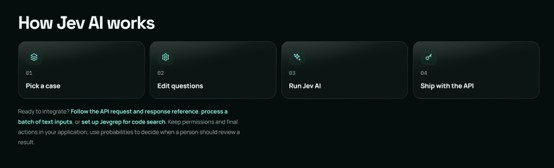
Developers can experiment with sample inputs in a playground before connecting an API to their applications.
Start with a small collection of real, appropriately handled examples. Define the available choices, establish a scoring rubric, and compare model results against decisions made by experienced team members.
Once the initial results are satisfactory, test the workflow on a larger dataset that includes ambiguous requests and unusual cases.
Keep the decision logic separate from the model. The AI evaluates information, while the application controls which actions are permitted.
Know When AI Should Not Make the Final Decision
Fast results are useful, but speed does not guarantee correctness.
A confidence score is not proof that a decision is accurate. Businesses should measure performance on representative examples and establish clear rules for escalating uncertain results.
Sensitive situations, including financial disputes, legal matters, and decisions that significantly affect individuals, may require additional verification and human oversight.
Decision models are also not substitutes for tools designed to perform exact calculations or produce detailed written explanations.
A reliable workflow uses the right technology for each task: deterministic software for calculations, generative AI for drafting, and decision-focused AI for classification and structured evaluation.
Measure Results Before Expanding Automation
After introducing decision-focused AI, monitor the outcomes rather than relying only on processing speed.
Useful measurements include routing accuracy, the number of cases requiring correction, the percentage of decisions escalated to humans, and the time employees spend resolving requests.
Review mistakes regularly. If the system frequently confuses billing questions with technical issues, adjust the categories, instructions, or escalation rules.
Businesses can also compare AI-assisted workflows with their previous manual processes to determine whether automation is genuinely improving operations.
Final Thoughts
Businesses do not always need AI to generate more content. Sometimes they need it to make existing information easier to act upon.
Decision-focused AI offers a practical way to transform unstructured requests into defined choices, probabilities, and scores. When combined with clear business rules and appropriate human oversight, these outputs can support faster and more consistent workflows.
The most effective approach is to begin with one repetitive decision, test the results carefully, and expand only when the process demonstrates measurable value.

What's your reaction?
You may also like
-

4 Ways to Simplify Property Cleanouts
-
7 Strategies for Strengthening Device Security
-
8 Nutrient-Packed Ingredients That Can Elevate Your Morning Smoothie
-
7 Reasons Racing Simulators Are Becoming the Ultimate Motorsports Experience
-
6 Ultimate American Dream Car Warranty Benefits Explained
-
10 Signs You Need to Hire a Handyman in Tallahassee















Comments
0 comment