




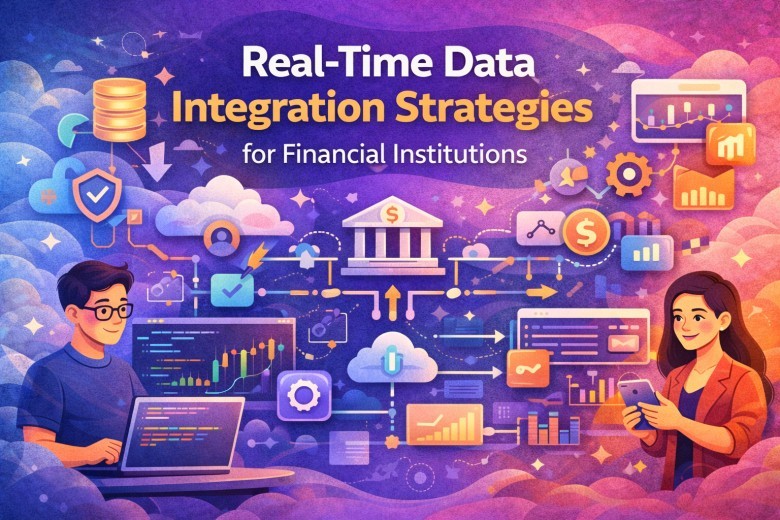
In today's hyper-connected financial ecosystem, data is more than an asset—it is central to decision-making, customer experience, compliance, and competitive advantage. As we move forward into 2026, financial firms face intense pressure to process, analyze, and act on data in real-time. Traditional batch processing systems are becoming a thing of the past.
Integrating data in real time is not merely a new technological capability; it is a strategic game changer. Fraud detection, algorithmic trading, personalized banking, and regulatory reporting are just examples of areas where the ability to unify data and process it instantly can make or break a financial organization.
This guide provides a deep dive into real-time data integration strategies used in financial institutions, including practical implementation advice, architecture patterns, and future-oriented approaches.
Understanding Real-Time Data Integration
Read data integration tools process the data as described before it is received and stored. Whereas batch processing collects and processes data at regular intervals, real-time integration allows the data to always be accurate and actionable.
For financial institutions, this means:
- Immediate fraud detection alerts
- Live transaction monitoring
- Real-time credit scoring
- Instant customer insights
- Dynamic pricing and risk modeling
What differentiates naive financial leaders from laggards is the move in the direction of not deferred bits of knowledge, yet to genuine time insight.
Why Real-Time Integration Matters in Finance
a. Fraud Detection and Prevention
The world of financial fraud is changing rapidly, and if it takes far too long to detect, it might cost you a pretty penny. Real-time data pipelines enable systems to detect problems immediately and take action to prevent harm before it can happen.
b. Regulatory Compliance
Regulatory landscapes are becoming more stringent and demanding accurate and timely reporting. Use real-time integration to stay compliant with up-to-date records and audit trails.
c. Customer Experience
Today’s customers demand real-time services, be it loan disbursement or transaction confirmation. Data in the moment allows for curated and reactive experiences.
d. Competitive Advantage
Leveraging real-time insights enables institutions to make quicker decisions, optimize operations, and offer enhanced services compared to rivals that still depend on legacy data systems.
Core Components of Real-Time Data Integration
For building a successful real-time data integration system, financial institutions need to comprehend its various components:
1. Data Sources
Such systems include transaction systems, CRM platforms, mobile apps, IoT devices, trading systems, and third-party APIs.
2. Data Ingestion Layer
Front Layer: Data that needs to be captured in real-time using technology such as an event streaming platform or a message queue.
3. Data Processing Engine
Processes incoming data streams with rules, algorithms, and machine learning models.
4. Data Storage
Encompasses both real-time databases and data lakes (for structured and unstructured data).
5. Data Delivery Layer
Pushes processed data to dashboards, applications, and analytics.
Key Strategies for Real-Time Data Integration
1. Event-Driven Architecture (EDA)
Real-time systems are based on event-driven architecture. In EDA, systems talk to each other using events — an event can an example is a transaction completed, or somebody logs in.
Benefits:
● Loose coupling between systems
● High scalability
● Faster response times
Financial institutions can use EDA to trigger workflows, such as fraud alerts and transaction validations, as well as customer notifications.
2. Stream Processing
Data Processing using stream processing is when you read and analyze information continuously as the data flows through the system.
Use Cases:
● Real-time trading analytics
● Risk assessment
● Payment processing
Actionable Insights Ingesting Streaming Data Modern stream-processing frameworks enable institutions to process millions of events per second with very low latency.
3. API-Led Integration
Cloud APIs serve as intermediaries, allowing communication and data exchange between applications and cloud providers.
Advantages:
● Flexibility
● Reusability
● Faster development cycles
APIs are used by banks and financial platforms to connect with fintech services, payment gateways, and third-party data providers.
4. Data Virtualization
Data virtualization provides a virtual unified view across multiple sources of data, instead of physically moving the data.
Benefits:
● Reduced data duplication
● Faster access to insights
● Simplified architecture
This is especially valuable for organizations working with legacy systems and multiple silos of data.
5. Cloud-Native Integration
Cloud platforms offer an elastic infrastructure for streaming integration.
Key Features:
● Elastic scalability
● High availability
● Cost efficiency
Global Stores adapts to the immense demand for peak loads without limits in infrastructure (cloud-native solution), increasing stability, flexibility, and reliability.
6. Hybrid Integration Models
The blend of legacy and modern systems is found in most financial institutions. Hybrid integration solutions are a mix of on-premise and cloud technology.
Why it works:
● Protects existing investments
● Enables gradual modernization
● Ensures business continuity
Architecture Patterns for Real-Time Integration
1. Lambda Architecture
Provides full analytics by combining batch and real-time processing
2. Kappa Architecture
Emphasizes solely on stream processing, no more batch layers
3. Microservices Architecture
The app is divided into several small, independent services that communicate through API.
All of these architectures provide different advantages based on the institution’s size, complexity, and regulatory considerations.
Challenges in Real-Time Data Integration
1. Data Security
Security: As an app that deals with sensitive financial information, ensuring security should be a fundamental priority.
2. Latency Issues
Even tiny delays would affect trading systems or fraud detection systems.
3. Data Quality
If your data is inconsistent or inaccurate, it can lead to bad decisions.
4. Legacy Systems
Legacy system integration with current platforms is not straightforward and can be an expensive process.
5. Scalability
Data volumes are growing, and flexible and scalable architectures need to introduce systems that give results efficiently.
Best Practices for Implementation
1. Start with a Clear Strategy
Make sure to set business objectives and use cases before real-time systems.
2. Invest in Scalable Infrastructure
Choose technologies that can support future growth.
3. Ensure Data Governance
Create policies for data quality, security and compliance
4. Use Automation
You are well-versed in data pipelines and automating those workflows to ensure a minimum number of manual errors.
5. Monitor and Optimize
Keep track of system performance and tune it for efficiency.
Role of AI and Machine Learning
Real-time Data Integration: Role of Artificial Intelligence
Applications:
● Predictive analytics
● Fraud detection
● Customer segmentation
● Risk modeling
Analyzing streaming data and getting meaningful insights on the go enables better decision-making with the help of machine learning models.
Real-Time Data Integration and Fintech Innovation
Real-time data integration strategies are being pioneered by fintech companies. Legacy financial institutions will need to evolve to compete.
Key trends:
● Open banking
● Embedded finance
● Instant payments
● Blockchain-based systems
Integration across banks and fintech platforms in real-time.
Intersection with E-Commerce and Digital Platforms
Interestingly, integration principles matter not only to real-time data pipelines connecting finance but also e-commerce ecosystems. The real-time data insights that offer crucial information to tools such as a prestashop seo module for optimizing product visibility, tracking customer behavior, and improving conversion rates.
Similar strategies can be leveraged by financial institutions establishing digital commerce or integrated modern financial services to:
● Monitor user behavior in real time
● Optimize financial product offerings
● Enhance cross-platform experiences
This alignment of finance and e-commerce illustrates the increasing need for integrated, real-time data ecosystems.
Security Considerations
The integration of financial data with other applications, however, requires consideration of security aspects.
Key Measures:
● End-to-end encryption
● Multi-factor authentication
● Real-time threat detection
● Compliance with global standards
Universities need to take a pro-security approach, whatever the time of year, ensuring that real-time systems do not pose as weaknesses.
Future Trends in Real-Time Data Integration
1. Edge Computing
Similar data processing closer to the source improves latency and performance.
2. Data Mesh Architecture
Data domains are handled by teams that own their data. Decentralized data ownership.
3. AI-Driven Integration
Complex data workflows will be managed by automation and intelligent systems.
4. Quantum Computing
Still in its infancy, quantum computing has the potential to fundamentally change how we process data.
5. Hyper-Personalization
The ability to view data in real time will lend itself to hyperpersonalized financial solutions that respond precisely to each customer.
Case Study Approach (Conceptual)
Imagine a digital bank implementing real-time integration:
- A customer initiates a transaction
- This instantly validates the transaction in the system
- Fraud detection algorithms are all examining the activity
- Risks are calculated in milliseconds
- The transaction is either accepted or flagged
- The customer receives a real-time notification
Such a seamless process can be achieved only due to attentive real-time data integration strategies.
Building a Roadmap for Adoption
● Phase 1: Assessment
Review existing systems and find gaps.
● Phase 2: Planning
Architecture, tools, and integration strategy definition.
● Phase 3: Implementation
Use data to deploy real-time pipelines and integrate systems
● Phase 4: Optimization
Monitor performance and refine processes.
● Phase 5: Scaling
Develop capabilities for larger data volumes and new use cases.
Conclusion
Integrating real-time data is no longer a choice for financial institutions, but a must. In 2026, with the financial world continuously in flux, institutions need to adopt contemporary data approaches to remain competitive, compliant, and customer-centric.
Implementing event-driven architectures, stream processing, cloud-native systems, and AI-powered analytics empowers financial services firms to leverage the potential of their data. Real-time systems help to reduce the time of communication and provide real information, which enhances growth and innovation.
What Industry convergence — particularly between finance and e-commerce really shows is that increased reliance on real-time data. Be it powering a banking service or optimizing a platform using something like prestashop seo module, the underlying core-rule is similar: precise, accurate, timely, as well as electronic details are crucial to succeed.
The financial institutions that will emerge from this new way of life to shape the future will be those who invest in real-time data integration capabilities today— agile, intelligent, and prepared for success in a more data-driven world.

What's your reaction?
You may also like
-

Why Small Roofing Problems Can Become Harder to Diagnose When Homeowners Delay Repairs
-
Planning a Stair Lift for Shared Homes Without Disrupting Everyday Staircase Use
-
Managing Household Waste During Large Decluttering Projects Without Creating New Clutter
-
How to Plan Impact Door Installation Around Security, Access, and Everyday Household Routines
-
How Commercial Roofing Maintenance Planning Helps Property Managers Track Roof Conditions
-
Designing Privacy Around Street-Facing Windows Without Giving Up Useful Natural Daylight













Comments
0 comment