




Global Tomato Product Market Report 2019-2026: Consumption Evolution, Bulk Supply Chain Insights, and Price Trend Forecasts
In the global food processing industry, tomato products consistently hold an irreplaceable core position. Despite extreme weather disruptions and global economic volatility over the past few years, global demand for tomato products has demonstrated remarkable resilience.
By deep-diving into buyer consumption data (the evolution of four major market segments) and supplier production data (climate shocks and production zone shifts), this article will provide a macro perspective on the global bulk tomato paste supply chain. We will use this to deduce 2026 price trends and provide forward-looking strategic warnings for B2B procurement professionals.
I. Macro Buyer Data: The Steady Expansion of Global Consumption Scale
Over the past seven years, after navigating short-term supply chain frictions, global tomato product consumption has shown a mild yet broad-based growth trend.
- Steady Climb in Total Volume: Global end-product sales volume climbed steadily from 32.6 million tonnes in 2019 to 35.3 million tonnes in 2025, achieving a cumulative growth of approximately 9%.
- Compound Annual Growth Rate (CAGR): The historical CAGR during this period was roughly 1.4%, a typical steady-growth model for a mature industry.
- A Resilient Consumption Base: Although total consumption briefly stalled (around 33.9 million tonnes) in 2022-2023 due to inflation and supply chain bottlenecks, the subsequent strong rebound proved its rigid demand nature as a foundational global food ingredient.
💡 Industry Terminology: Raw Material Equivalent
Tomato products are measured not just by "finished product weight," but more importantly by "raw material equivalent"—meaning how many fresh tomatoes were consumed to produce these goods. Based on 2019-2025 sales volumes, global annual consumption of fresh processing tomatoes has stabilized between 37 million and 39 million tonnes. This forms the foundational production capacity base for global tomato farming and processing.
II. The 2025 Landscape of Four Core Market Segments
By the end of 2025, the 35.3 million tonnes of tomato products consumed globally were highly segmented into four main arenas. The buyer demand drivers for each category are vastly different:
|
Segment |
2025 Consumption |
Market Share |
Core Consumption Zones & Growth Drivers |
|
Ready Meals & Soups |
18.6M tonnes |
52.7% |
Largest Volume. Driven by "Northwestern Hemisphere" markets like the US, UK, and France; extensively used in frozen pizzas, commercial pasta sauces, and modern pre-packaged meals. |
|
Sauces & Ketchup |
9.6M tonnes |
27.2% |
Fastest Growing. The Asia-Pacific region is the core growth engine (consumption surged 30% to 2.7M tonnes), closely followed by Latin America. |
|
Tomato Pastes & Purées |
4.1M tonnes |
11.6% |
Moderate Growth. Mainly concentrated in "Mediterranean regions" like Italy and Portugal, used as a fresh foundational seasoning for scratch-cooking at home. |
|
Canned & Ambient |
3.0M tonnes |
8.5% |
Mature & Stable. The smallest and most mature segment, with a CAGR of only about 0.9%. |
III. The Supply-Demand Clash: Market Dynamics of Industrial Bulk Tomato Paste
As the "foundational raw material" for the four categories above, the market dynamics of bulk tomato paste (with a global annual demand of ~3.9 million tonnes) directly determine the profit margins of downstream food factories. In recent years, both supply and demand sides have experienced three drastic shifts:
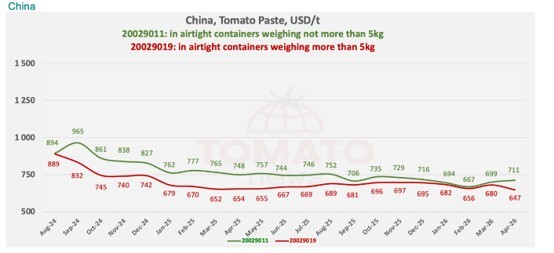
图表 1tomato paste price
1. The Buyer Side: High Inflation Drives the "Affordable Substitute" Frenzy
The high inflation environment from 2022 to 2025 fundamentally altered consumer shopping carts. As expensive fresh produce lost favor, consumers pivoted en masse toward low-cost traditional packaged foods.
💡 Industry Terminology: Private Label
Facing a consumer downgrade, downstream food processing plants began purchasing bulk tomato paste in massive quantities to produce "private label" products for supermarkets (e.g., store-brand pasta sauces for major retailers). These products eliminate marketing costs, offer extreme value, and became the primary consumers of bulk tomato paste during the inflationary period.
2. The Supply-Demand Corridor: The "Southward and Eastward Shift" of Global Trade Centers
Traditional European and American import markets are nearing saturation, while the Middle East and West Africa have emerged as "hotspot corridors" for bulk tomato paste imports, with year-over-year import volumes surging by 27% and 28%, respectively. To fill this massive gap, origin production regions like China (especially the Xinjiang region, exporting over 1.2 million tonnes annually) and Iran are becoming core suppliers meeting the explosive demand of emerging markets.
3. The Supplier Side: Extreme Climate Triggers a Capacity Crisis
While demand grows, the supply side is repeatedly sounding alarms. Throughout late 2024 to 2025:
- Major European production regions (Spain, Italy) suffered severe heatwaves, leading to a sharp decline in agricultural output.
- California and certain major production areas in China underwent rational adjustments in arable land area.
This compounding effect has severely tightened the global supply of premium bulk raw materials.
IV. Data Resonance Deduction: 2026 Price Trend Forecasts and Market Maneuvering
Based on the data resonance between "resilient buyer demand (the substitute effect and emerging market explosions)" and "constrained supplier capacity (climate shocks and production zone shifts)," the logical price trend for global bulk tomato paste in 2026 is exceptionally clear: High-level volatility, prone to rise and hard to fall.
The core underlying logic driving this price trend encompasses three dimensions:
1. Historically Low "Carry-over Inventory" Supports the Price Floor
The massive production drops in major European regions during 2024 and 2025 not only consumed that season's capacity but severely depleted global "Carry-over Inventory." Until the 2026 new harvest season yields a large-scale crop and forms substantial supply, spot goods will remain extremely scarce in the market. This establishes a rock-solid floor for prices in the first half of 2026, making significant downward corrections highly unlikely.
2. Production Zone Concentration Triggers a "Seller's Market" Effect
With European capacity constrained, global procurement demand is accelerating its concentration toward core supply belts like China (e.g., the Xinjiang region). This "siphon effect" of orders grants origin factories—those with stable processing capabilities and their own premium tomato fields—stronger pricing power. Premium, high-concentration (28-38% Brix) Cold Break and Hot Break drum tomato paste will face a scenario where "securing even one container is difficult."
3. Hidden Cost Markups: Severe Volatility in Ocean Freight Rates
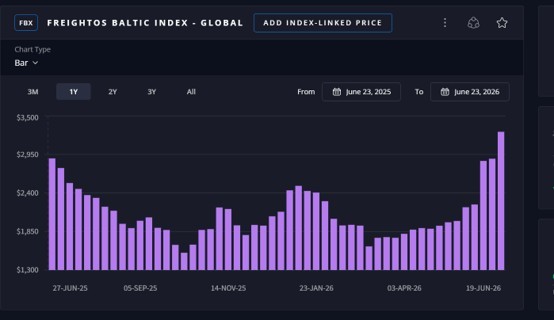
Procurement costs in 2026 are not merely a battle over "FOB prices," but a challenge of total landed costs (CIF/DDP). With persistent tension in global shipping hubs and episodic port congestion, exorbitant and highly unstable ocean freight rates will be passed directly onto the procurement cost of every ton of tomato paste as a "hidden premium."
(Please refer to the latest freight trend below)
图表 2Freight price trends
As illustrated in the 2026 freight index above, ocean shipping rates from major Northern Chinese hubs to key destination ports in the Middle East and Europe remain highly volatile. This unpredictable CIF/DDP cost structure underscores the absolute necessity of partnering with an integrated supply chain manufacturer who possesses robust port-direct resources to secure stable, long-term shipping allocations.
V. Ultimate Advice for Procurement Directors: How to Lock in Profits in a Volatile Market?
The 2026 market's shift from "excess inventory" to "tightened supply" places incredibly high demands on the supply chain resilience of every B2B procurement professional. Over-relying on a single production region or attempting to "bottom-fish" for cheap spot goods will leave your raw material costs entirely exposed to the dual risks of supply cuts and skyrocketing freight rates.
The most astute supply chain strategy is: Shift from "Spot Procurement" to "Strategic Long-term Contracts."
Facing the dual challenges of raw material shortages and ocean freight volatility, the only defensive moat to shield downstream food manufacturing lines from price surges and secure year-round uninterrupted supply is to act early. Partnering with an origin factory that possesses production zone integration capabilities and direct-port shipping advantages to sign Long-term Contracts, thereby locking in shipping schedules and premium raw materials in advance, will be crucial for the coming year.

What's your reaction?
You may also like
-

Why Small Roofing Problems Can Become Harder to Diagnose When Homeowners Delay Repairs
-
Planning a Stair Lift for Shared Homes Without Disrupting Everyday Staircase Use
-
Managing Household Waste During Large Decluttering Projects Without Creating New Clutter
-
How to Plan Impact Door Installation Around Security, Access, and Everyday Household Routines
-
How Commercial Roofing Maintenance Planning Helps Property Managers Track Roof Conditions
-
Designing Privacy Around Street-Facing Windows Without Giving Up Useful Natural Daylight
















Comments
0 comment